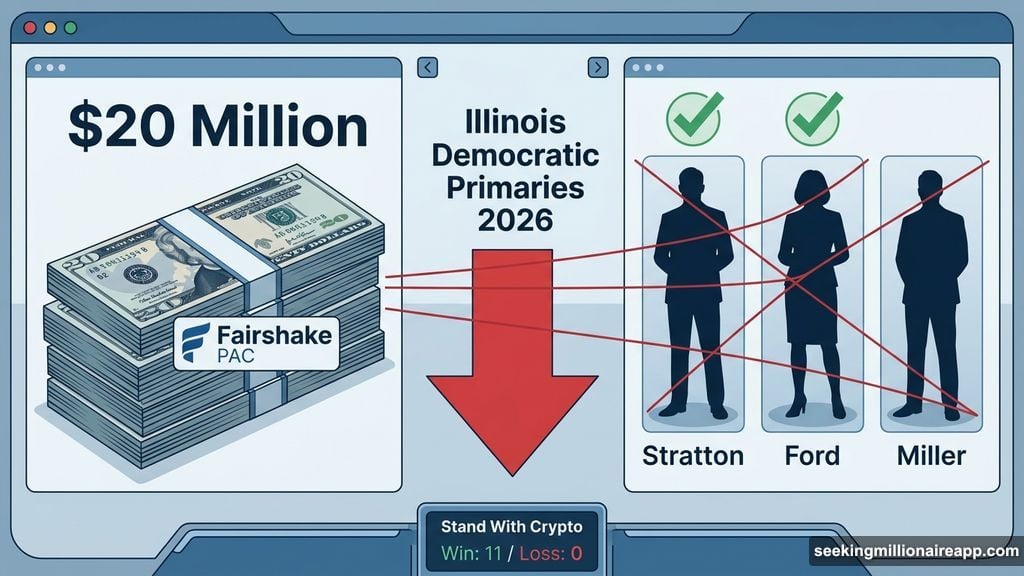
The crypto industry just learned a hard lesson about political spending. In Illinois’s Democratic primaries, Fairshake and its affiliated PACs dropped nearly $20 million trying to shape outcomes. Most of their targets won anyway.
For a political operation that spent 2024 looking unstoppable, this stings. And it raises a real question about whether money alone can move Democratic primary voters on crypto-related issues.
Lt. Gov. Stratton Walks Away With the Win
The biggest loss for Fairshake came in the Democratic Senate primary, where Lt. Gov. Juliana Stratton survived more than $10 million in spending against her.
Stratton was gunning for the seat being vacated by retiring Sen. Dick Durbin. Fairshake made her the primary target of its Illinois campaign. She won the nomination anyway.
The PAC and its affiliate Protect Progress also poured millions into boosting her rivals, US Reps. Raja Krishnamoorthi and Robin Kelly. Neither of them made it through. So Fairshake essentially spent over $10 million on a Senate race and got nothing to show for it.
State Rep. Ford Told Them to Stop. Then He Won.
Further down the ballot, State Rep. La Shawn Ford won his Illinois House primary despite nearly $2.5 million in crypto spending against him. Ford didn’t just survive the campaign, though. He fought back. In the days before his victory, his team sent a cease-and-desist order demanding that Fairshake stop running attack ads against him.
Then he won. That’s a memorable sequence of events for a PAC that’s used to getting its way.
Fairshake Did Find a Few Wins
To be fair, Illinois wasn’t a total shutout. Cook County Commissioner Donna Miller won her race after the PAC spent over $800,000 against her progressive rival, state Sen. Robert Peters. Former representative Melissa Bean and incumbent representative Nikki Budzinski also secured victories with the crypto lobby’s backing.
All three appear as “strongly supportive of crypto” on the Stand With Crypto politician scoreboard, which is run by the Coinbase-backed NGO. So Fairshake did move the needle in some races. But those wins look modest compared to the losses.
A Different Story Than 2024
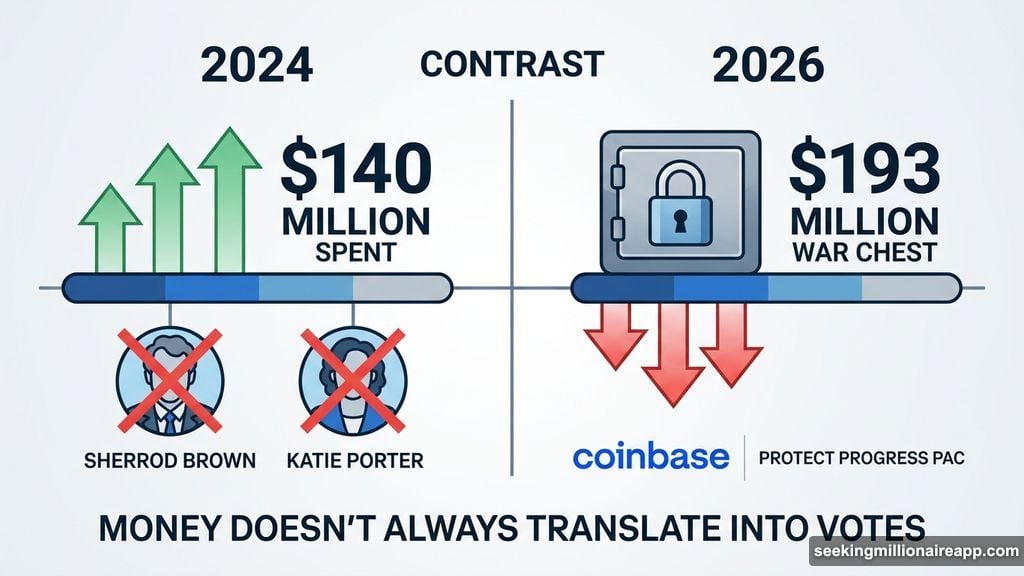
Illinois is a sharp contrast to what Fairshake pulled off just a cycle ago. In 2024, the PAC spent close to $140 million across congressional races. It helped topple high-profile crypto skeptics, including former Senate Banking Committee chair Sherrod Brown. It also buried Katie Porter’s California Senate bid with more than $10 million in outside spending.
Coming off that run, Fairshake entered 2026 with $193 million in its war chest. One of the largest PAC reserves in the country. That’s a lot of firepower. And yet Illinois showed it doesn’t always translate into votes.
Why the Spending Didn’t Land
Part of the issue may be the PAC’s approach. Critics noted that Fairshake’s ads barely mention crypto at all. Instead, they tend to focus on attacking targeted candidates using more general political messaging. That strategy drew pushback from rival campaigns and left voters confused about what the spending was actually about.
But the deeper issue might be simpler. Democratic primary voters remain genuinely divided on crypto regulation. Public opinion in those races is unsettled. And that uncertainty creates room for candidates the industry opposes to make their case directly to voters.
Spending $10 million against someone doesn’t automatically make them unelectable. Especially when voters haven’t decided what they think about the issue driving that spending.
What This Means Going Forward
Fairshake still has enormous resources and a track record that most political operations would envy. One tough night in Illinois doesn’t erase 2024. But it does suggest that the PAC’s formula has limits, particularly in Democratic primaries where voters may be more skeptical of crypto-aligned messaging.
The industry still has a clear political strategy and the money to back it up. Whether that strategy needs retooling after Illinois is a conversation worth watching. Because if millions in spending can’t move a Democratic Senate primary, the next question is what happens when that money meets even more organized resistance.
Illinois might just be the first sign that pushback is coming.