
Global money supply just hit a record $144 trillion. Hard assets should be surging. Gold is. Bitcoin isn’t.
That disconnect is puzzling a lot of investors right now. And frankly, it makes more sense than it first appears. The answer comes down to what Bitcoin actually is — and that question turns out to be more complicated than crypto fans would like to admit.
Record Liquidity Should Float All Hard Assets
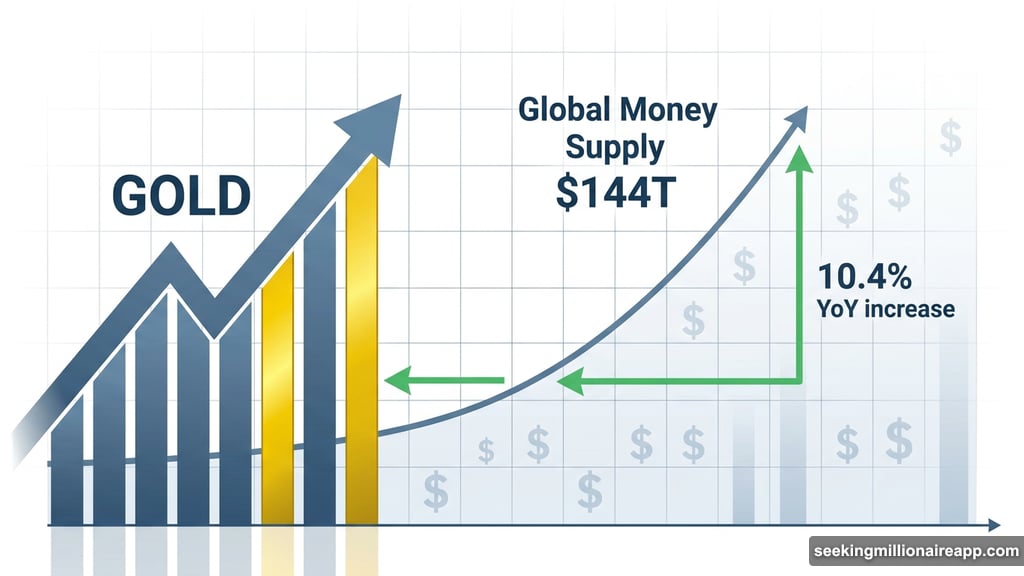
The numbers are striking. According to the Kobeissi Letter, global broad money supply reached $144 trillion in December 2025. Year-over-year, that’s a $13.6 trillion increase — up 10.4%.
December also marked the third straight month of accelerating growth. And the broader trend is even more dramatic. Since the 2020 pandemic, global money supply has expanded by $44 trillion — a 44% jump. The fastest single-month surge happened in February 2021, clocking in at 18.7%.
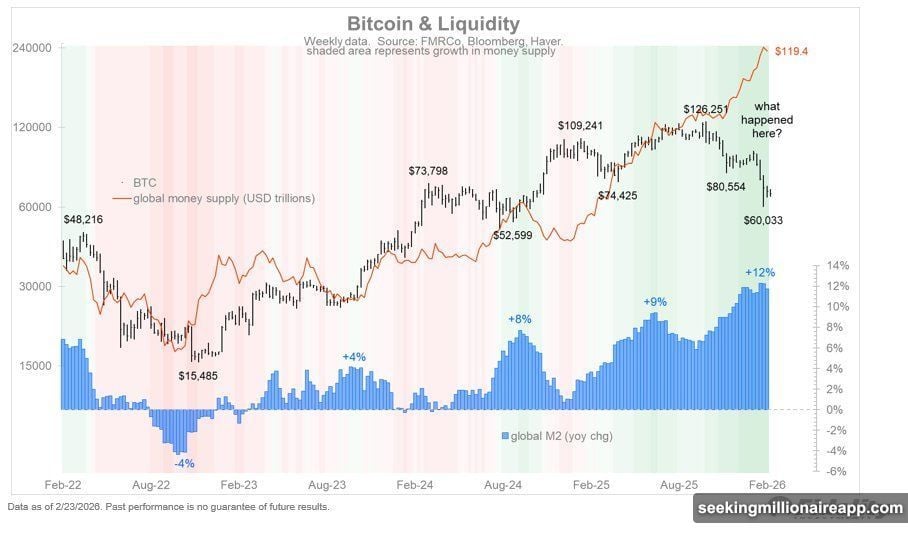
In other words, money creation has rarely moved this fast outside of an outright crisis. So the big question becomes: where is all that liquidity going?
Gold Is Following the Script
Gold has a clear answer. Jurrien Timmer, Director of Global Macro at Fidelity, put it plainly: gold is tracking global money supply almost in lockstep.
Yes, the metal suffered a sharp 21% drawdown earlier this year. But it bounced back quickly. Timmer describes it as textbook bull market behavior — short, painful dips that attract buyers fast. The broader uptrend stays intact.
The reason is straightforward. Gold has one identity. It’s hard money. Full stop. When liquidity expands, investors park capital in gold as an inflation hedge and store of value. That relationship has been consistent for decades.
Bitcoin’s Dual Identity Is the Problem
Bitcoin’s story is messier. Timmer points out that BTC occupies two roles simultaneously — and those roles are currently pulling in opposite directions.
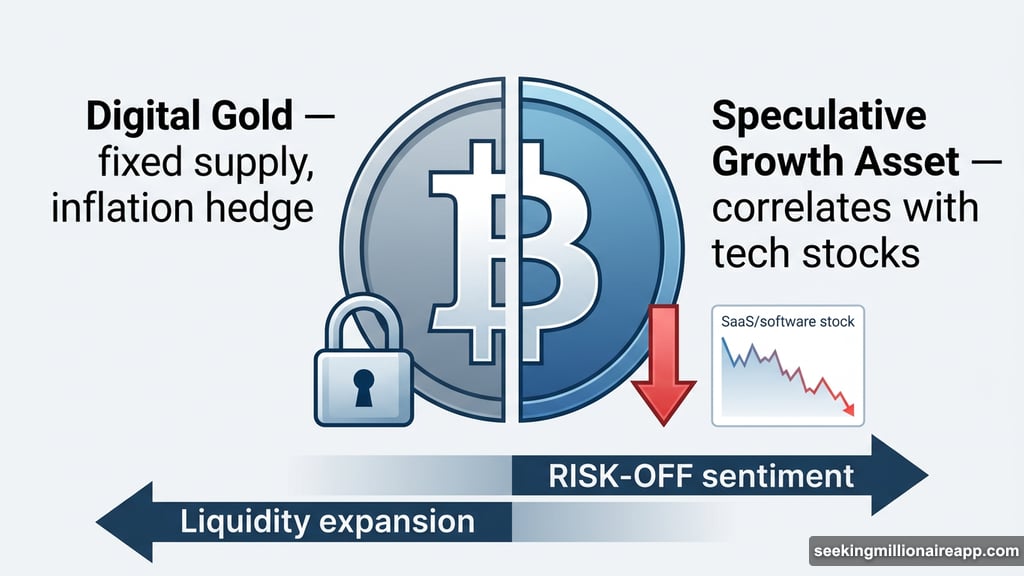
On one hand, Bitcoin carries the “digital gold” narrative. Fixed supply, decentralized, resistant to inflation. That story suggests it should track global money supply just like gold does.
On the other hand, Bitcoin trades like a speculative growth asset. It correlates with tech stocks, risk appetite, and market sentiment. When investors feel bold, they pile in. When fear returns, they flee.
Right now, fear is winning.
When Speculation Retreats, Liquidity Loses
Timmer adds an important layer to the analysis. When you combine money supply growth with the rate of change in software and SaaS stocks — a solid proxy for speculative appetite — a clear pattern emerges.
Expanding liquidity AND strong speculation creates powerful bull markets for Bitcoin. The two forces compound each other. But the reverse is equally true.
Pull speculation out of the equation, and liquidity alone cannot sustain Bitcoin’s price. The tailwind from money creation gets overridden by the headwind from risk-off sentiment.
That’s exactly the situation playing out right now. As Timmer put it directly: “We have ample liquidity growth but a bear market in speculation. The result: Bitcoin is languishing while gold and the money supply are rallying.”
What Would Change the Picture
The gap between gold and Bitcoin won’t close until speculative appetite returns to crypto markets. That’s the missing ingredient.
More liquidity helps. But it’s not enough on its own. Bitcoin needs investors to feel comfortable taking on risk again — the kind of sentiment that drove the 2021 bull run or the late-2024 surge.
Whether that shift happens soon is genuinely uncertain. Macro conditions remain mixed. Rate expectations are unclear. And broader tech sector momentum has cooled considerably.
Gold, meanwhile, needs none of that. It just needs the money supply to keep growing. And right now, it absolutely is.
The lesson here is worth holding onto. Bitcoin and gold share some DNA, but they’re not the same animal. When global liquidity expands during risk-on periods, Bitcoin can dramatically outperform gold. But when risk appetite contracts, gold’s single identity gives it a huge structural advantage.
Investors treating Bitcoin purely as a liquidity hedge are working with half the picture. The speculative component isn’t a side story — it’s central to how BTC actually moves. Until that piece of the puzzle snaps back into place, gold has the cleaner trade.