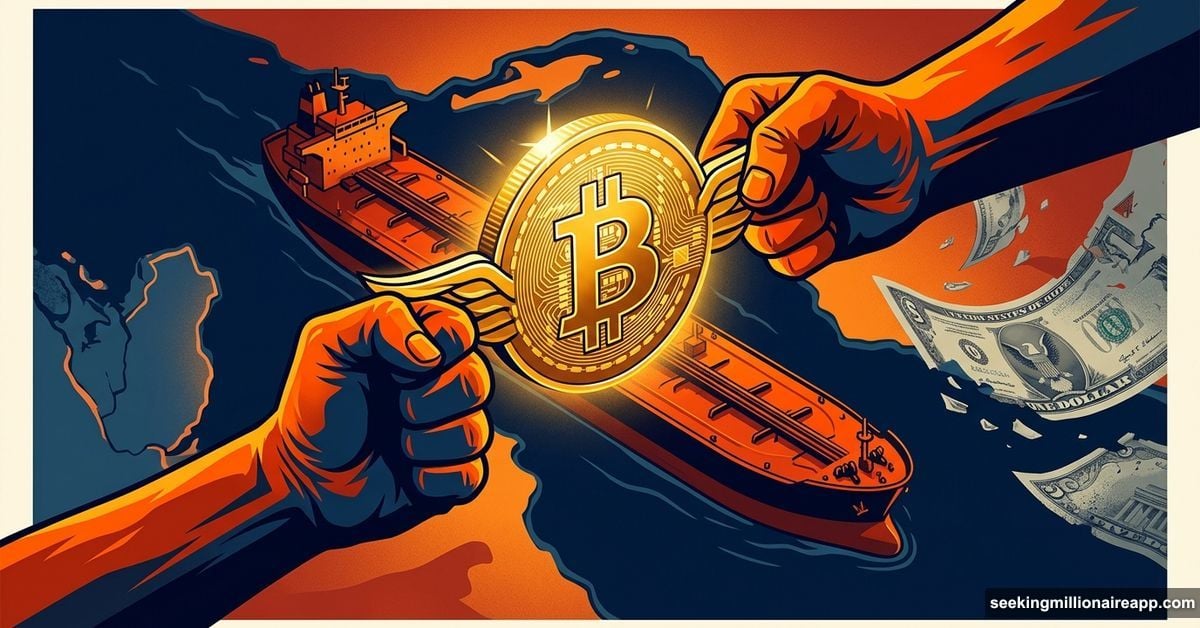
Something wild just happened in global oil politics. Iran announced it will charge shipping companies up to $2 million per tanker in Bitcoin to pass through the Strait of Hormuz during a two-week ceasefire window.
That’s not a minor diplomatic footnote. It’s a direct shot at the dollar-dominated oil trade system that has shaped global finance for decades. And the way Iran structured the payment demand makes it even more fascinating.
Bitcoin Tolls at the World’s Most Critical Chokepoint
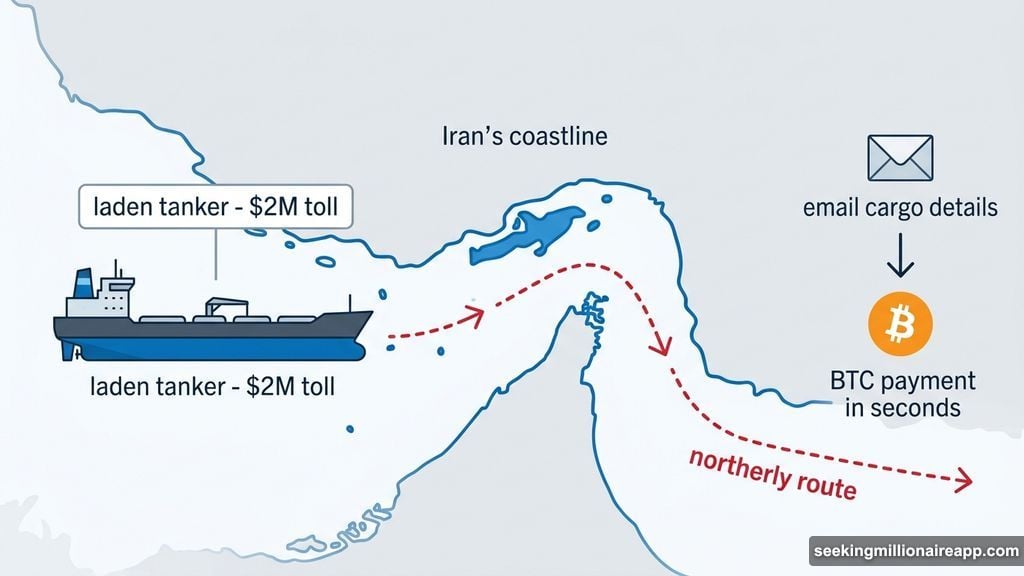
Here’s how the scheme works. Every laden tanker wanting to cross the Strait of Hormuz must email Iranian authorities with full cargo details. Iran then calculates a toll of $1 per barrel of oil carried.
For a fully loaded supertanker, that adds up fast. We’re talking up to $2 million per crossing. Empty tankers, however, get to pass freely.
Then comes the really striking part. Once Iran sends back the toll amount, the ship has only seconds to pay in Bitcoin. Hamid Hosseini, spokesperson for Iran’s Oil, Gas and Petrochemical Products Exporters’ Union, told the Financial Times that this tight window is entirely deliberate. The speed of the transaction makes it nearly impossible to trace or seize under international sanctions.
So Iran essentially engineered a payment system that sidesteps the entire Western financial enforcement apparatus in one move.
Military Force Is Part of the Package
This isn’t just a financial maneuver. Iran backed the toll demand with a serious military threat. Tankers operating in the Gulf received a radio broadcast warning this week that any vessel attempting transit without Iranian approval would face military strikes.
The message was direct: unauthorized passage means destruction.
Hosseini also indicated that Tehran expects tankers to use the northerly route, which runs close to Iran’s coastline. That routing requirement raises obvious questions for Western-aligned or Gulf-state shipping operators. Do they pay Bitcoin tolls to Iran? Do they risk the alternative route? Or do they avoid the strait entirely?
None of those options are comfortable.
Washington and Tehran Are on a Collision Course
President Trump has made the Strait of Hormuz central to the ceasefire agreement. His position is clear: any deal requires the complete, immediate, and safe reopening of the waterway. No conditions. No tolls.
Iran’s Supreme National Security Council sees things differently. The council put forward 10 negotiation points, all of which include military oversight of transit activity through the strait. That’s essentially the opposite of what Washington is demanding.
So right now, both sides are staking out hardline positions on the same piece of water. The ceasefire itself may hinge on who blinks first.
What This Means for the Petrodollar
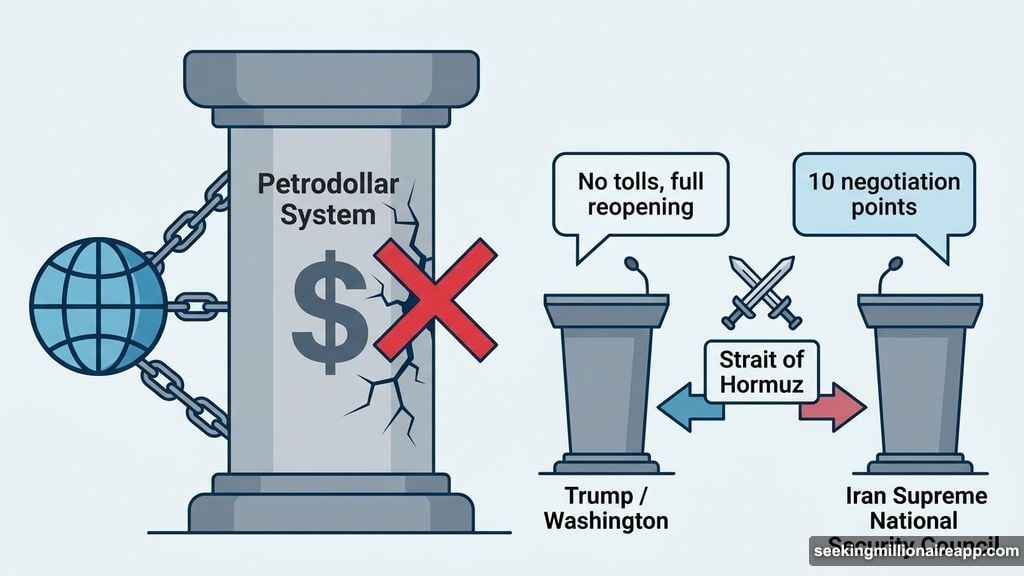
For decades, oil has been priced and traded almost entirely in US dollars. That arrangement gives Washington enormous leverage over global energy markets and helps sustain demand for the dollar worldwide.
Iran’s Bitcoin toll scheme pokes directly at that foundation. By forcing ships to settle in crypto rather than dollars, Tehran creates a precedent. Other nations watching this standoff will notice. If a major oil transit chokepoint can operate on Bitcoin payments, the assumption that oil equals dollars gets a little shakier.
That’s not to say the petrodollar collapses overnight. But this move shows that alternative payment rails for energy trade are no longer theoretical. They’re being deployed in real-time, under military threat, at one of the most strategically vital waterways on the planet.
The Seconds-Long Payment Window Is Genius and Terrifying
It’s worth dwelling on that payment timing for a moment. Iran didn’t just choose Bitcoin casually. The whole system is designed around Bitcoin’s irreversibility and speed.
Once a Bitcoin transaction broadcasts to the network, it cannot be recalled or frozen by a bank. Traditional dollar wire transfers can be blocked, reversed, or seized by US authorities invoking sanctions. A Bitcoin payment completed in seconds leaves no window for that kind of intervention.
Iran essentially built a sanctions-proof toll booth. And they did it with publicly available blockchain technology that anyone can access.
Whether shipping companies actually comply, whether Western governments can pressure them not to, and whether the ceasefire holds at all remain genuinely open questions. But one thing is already clear: Iran just demonstrated that crypto isn’t just a retail investment vehicle. In the right hands, it’s a geopolitical tool with real teeth.
How this standoff resolves will shape not only the ceasefire’s survival, but also how seriously global powers take cryptocurrency as a mechanism for bypassing financial sanctions going forward. Both outcomes matter enormously.