MicroStrategy stock is quietly winning a race nobody expected it to enter.
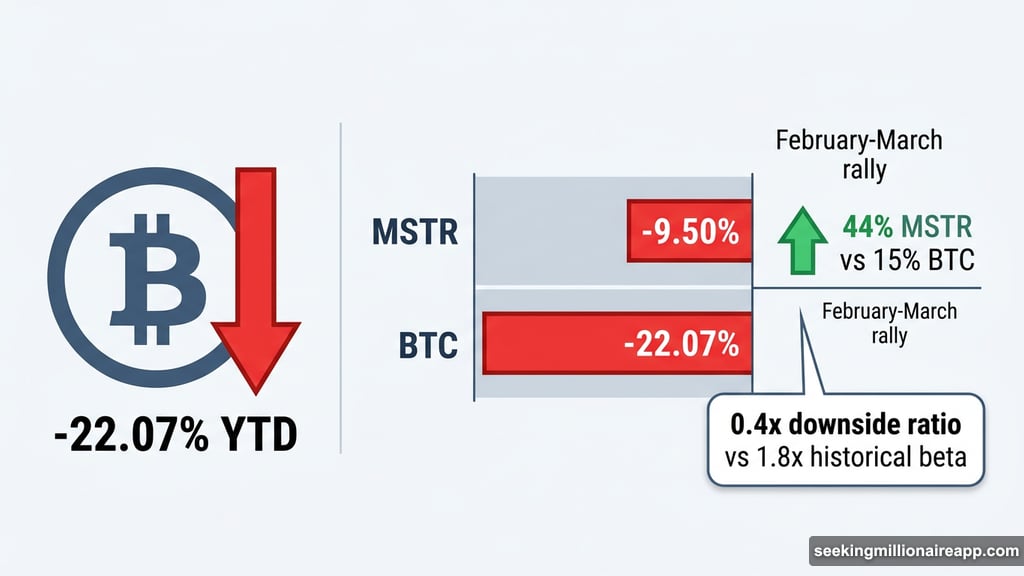
While Bitcoin has shed over 22% year to date, MicroStrategy shares (MSTR) are down just 9.5%. That’s a striking gap for a company whose entire identity is built around holding Bitcoin. So what’s actually going on here?
The answer involves smart money flows, a preferred stock dividend, and a volatility pattern that’s flipped in shareholders’ favor.
Bitcoin Dropped 22%, But MSTR Absorbed Less Than Half That
Historically, MicroStrategy has carried a 1.5x to 1.8x beta to Bitcoin. That means when Bitcoin moves, MSTR tends to move even harder in the same direction. But 2026 has broken that pattern on the downside.
Bitcoin is down 22.07% year to date. MicroStrategy is down just 9.50%. That puts the actual downside ratio closer to 0.4x, not 1.8x. So instead of amplifying Bitcoin’s losses, MSTR absorbed less than half of them.
On the upside, however, the amplification is very much alive. Between February 5 and March 6, Bitcoin rose about 15% within its range. MicroStrategy climbed roughly 44% over the same period. That’s closer to a 3x multiplier going up.
For comparison, Microsoft is down 14.26% year to date. Tesla is down 12.60%. Amazon is down 8.14%. Both the S&P 500 and Nasdaq-100 are in the red. MicroStrategy is outperforming most of the Magnificent Seven despite holding an asset that has dropped more than a fifth of its value this year.
Institutional Money Flows Tell an Interesting Story
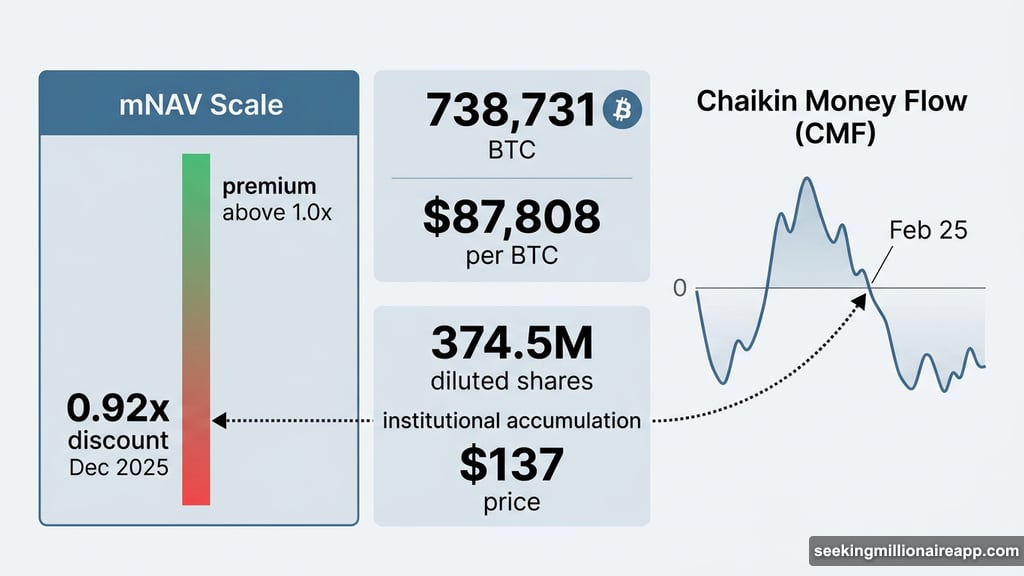
The Chaikin Money Flow (CMF) indicator, which tracks buying and selling pressure from larger market participants, crossed above zero around February 25. That’s notable because it happened while the stock price was still trending lower from its mid-January peak.
Rising money flow during a falling price typically points to institutional buyers quietly accumulating shares at discounted levels. The divergence between the two signals confirmed that larger players were building positions rather than fleeing.
As of early March, however, CMF is starting to dip back down. That shift connects directly to what happened with the mNAV.
The mNAV Discount Window Has Closed
The mNAV, or multiple to net asset value, measures whether MicroStrategy’s market cap is trading at a premium or discount to the Bitcoin it actually holds. A reading below 1.0x means the stock is cheaper than its underlying Bitcoin, which is exactly the kind of setup that draws institutional capital.
In late December 2025, diluted mNAV hit 0.92x. With 342.97 million diluted shares at $158.81 versus 671,268 BTC at $87,808, investors could buy MSTR shares at roughly an 8% discount to the Bitcoin on the balance sheet. That’s a real arbitrage opportunity for big money.
Over the following weeks, CMF crossed above zero. Institutional buyers stepped in. Now, with 374.5 million diluted shares trading above $137 and 738,731 BTC worth approximately $51.1 billion at current prices, the diluted mNAV has moved back to 1.01x. The discount window has closed, and CMF is easing accordingly.
STRC Preferred Stock Keeps Income Investors in the Picture
Even as the mNAV discount disappeared, one element continues drawing a different kind of buyer: STRC, Strategy’s Variable Rate Series A Perpetual Preferred Stock.
STRC pays an 11.50% annualized dividend, distributed monthly in cash. That marks the seventh consecutive rate hike for the preferred shares. For income-focused investors who want yield without direct Bitcoin exposure, that return is genuinely compelling in any market environment.
On-Balance Volume (OBV), a proxy for retail investor interest, trended higher throughout the entire price rise phase, even as the mNAV discount disappeared. STRC’s yield likely explains why retail interest kept building even when the institutional discount trade was already fading.
So the full picture for 2026 looks something like this. When Bitcoin drops, MSTR drops too, but at a softer ratio. The mNAV compresses below 1.0x, reopening the discount window for common equity buyers. When Bitcoin bounces, MSTR rises roughly three times faster, mNAV re-expands above 1.0x, and Strategy can raise capital at a premium to buy more Bitcoin. Meanwhile, STRC holders collect their monthly cash dividend through both scenarios. Both sides of the trade feed the treasury.
It reads less like a risk and more like a designed feature.
A Close Above $140 Could Trigger a 29% Move
The technical setup adds another layer to the fundamental case. Between early January and early March, MSTR’s price carved out lower lows while the Relative Strength Index (RSI), a momentum indicator, printed higher lows. That classic bullish divergence was active through March 6.
The rising channel from February 5 remains intact. Using Fibonacci levels drawn from that channel’s base, MSTR is currently sitting near the 0.5 level at around $136. The next meaningful resistance sits at the 0.618 Fibonacci level at $140, just about 3% above current pricing.
A daily close above $140 would confirm a breakout from the upper half of the consolidation range. From there, targets open at the 1.0 Fibonacci level at $154 and the 1.618 extension at $176. That $176 target represents roughly a 29% move from current levels.
Given the 3x upside beta observed during this channel, Bitcoin would only need to bounce about 10% to fuel a rally of that magnitude in MicroStrategy shares. That’s a relatively low bar for an asset that has already dropped 22%.
The Other Side of the Trade
Of course, the setup isn’t without risk. A drop below $136 would put pressure on the current structure. If MSTR breaks the $132 level, which corresponds to the 0.382 Fibonacci, the bullish divergence from March 6 weakens considerably. That opens a path toward $126 and potentially the channel floor near $118.
But here’s the key point. Even in that bearish scenario, the 2026 beta profile suggests MSTR absorbs only about 0.4x of Bitcoin’s downside. And a deeper Bitcoin correction would simply push the mNAV back below 1.0x, reopening the same discount window that attracted institutional capital in late 2025.
For existing shareholders, the math continues to work in both directions. For anyone watching from the sidelines, the $140 level is the one to watch.