
Prediction markets just got a powerful new player behind the scenes. Venture capital firm Paradigm is reportedly developing a professional trading terminal aimed squarely at institutional traders and market makers in the prediction market space.
According to Fortune, Paradigm partner Arjun Balaji is leading the project, which sources say has been in development since late 2025. For a firm that’s already one of the biggest backers of Kalshi, this move signals serious long-term confidence in where prediction markets are headed.
Kalshi’s Biggest Backer Goes Even Deeper
Paradigm isn’t new to prediction markets. The VC firm participated in three successive funding rounds for Kalshi throughout 2025. That loyalty paid off fast. Kalshi recently raised more than $1 billion in a new funding round, pushing its valuation to a staggering $22 billion.
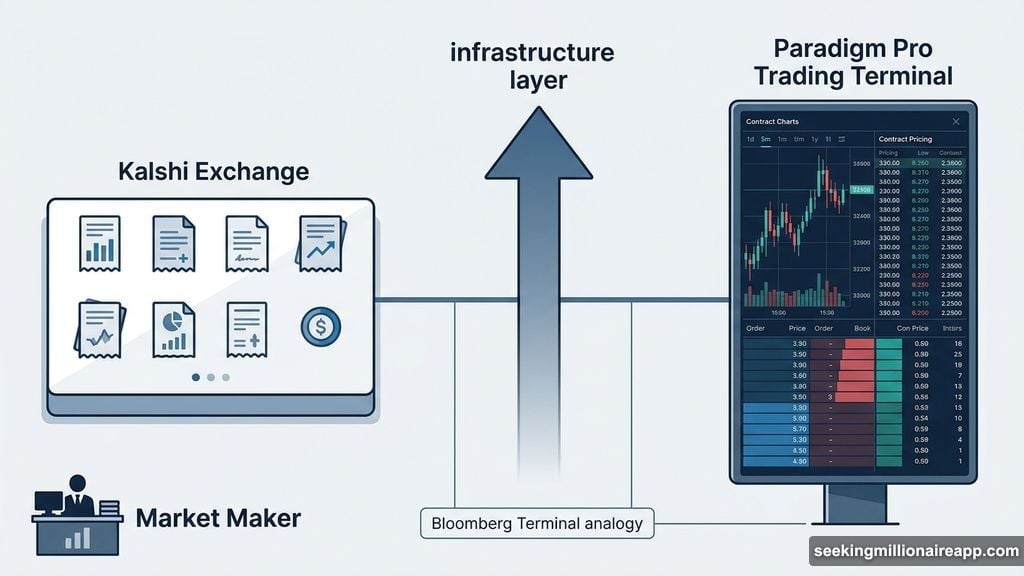
Paradigm co-founder and managing partner Matt Huang sits on Kalshi’s board of directors. So when reports surfaced about Paradigm building its own trading terminal, some eyebrows went up. But sources were quick to clarify the situation. The terminal isn’t designed to compete with Kalshi’s platform. Instead, it targets a layer of infrastructure that simply doesn’t exist yet for professional prediction market traders.
Think of it like the difference between a stock exchange and Bloomberg Terminal. Kalshi is the exchange. Paradigm wants to build the pro-grade tools sitting on top of it.
Market-Making Desks and Prediction Market Indexes
The terminal is just one piece of a bigger puzzle Paradigm appears to be assembling. Sources suggest the firm has explored setting up an internal market-making desk. That would let Paradigm directly provide liquidity in prediction markets, a critical function that makes these markets more efficient and reliable for everyone.
Beyond that, a separate source told Fortune that Paradigm has engaged researchers to study the feasibility of prediction market indexes. If that sounds familiar, it should. Indexes changed how people invest in stocks. A prediction market index could do something similar for this emerging asset class.
Plus, Paradigm has already started collecting prediction market data into a public dashboard. That’s a quiet but meaningful move. Good data infrastructure is often the first sign that serious institutional players are preparing for something bigger.
A Market That Exploded Almost Overnight
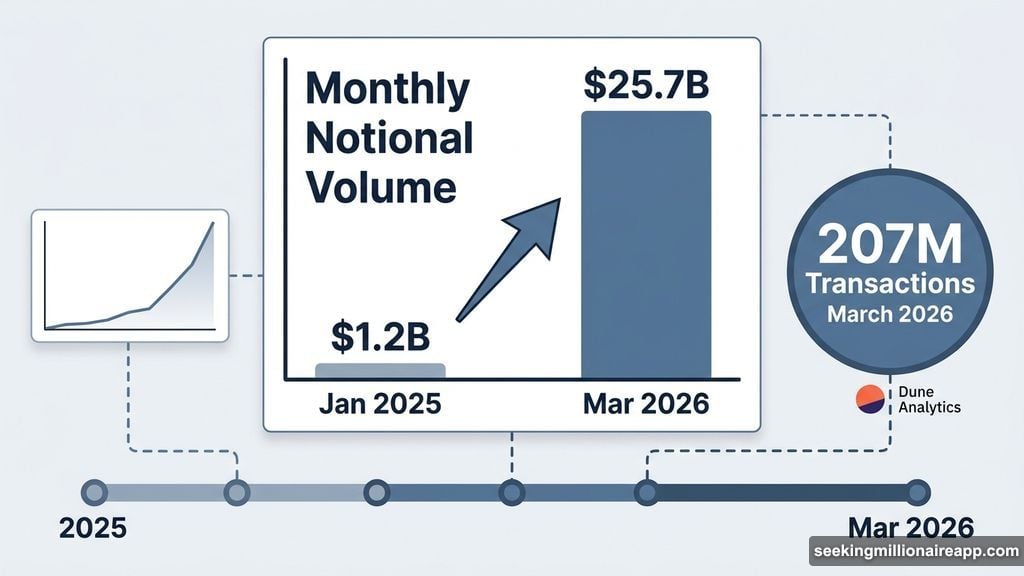
Paradigm’s timing here is worth noting. Prediction markets aren’t a niche hobby anymore. Transactions surpassed a record 207 million in March 2026 alone, according to Dune data. Monthly notional volume hit roughly $25.7 billion, up from just $1.2 billion in early 2025. That’s not gradual growth. That’s a sector rewriting its own records month after month.
And the big players have noticed. Binance is currently beta-testing an in-app prediction market feature inside its Wallet app. Coinbase unveiled its own prediction market offering through a partnership with Kalshi back in January. Crypto.com launched a standalone platform called OG.
So everywhere you look, major exchanges are rushing to stake their claim. Paradigm’s play is different, though. Rather than launching another prediction market platform, the firm seems focused on the professional trading infrastructure layer. That’s a smart bet in a maturing market.
Why Pro Infrastructure Matters Now
Right now, prediction markets lack the sophisticated tools that professional traders expect in other financial markets. There’s no Bloomberg Terminal equivalent. There’s no standardized index for broad market exposure. Liquidity can be inconsistent, which scares off serious institutional capital.
That’s the gap Paradigm appears to be targeting. A professional terminal with proper data feeds, order management, and analytics could open prediction markets to a much larger pool of institutional capital. Add a market-making desk and you solve the liquidity problem. Add indexes and you give institutions a simple way to gain exposure without picking individual contracts.
These aren’t glamorous products. But they’re exactly what a market needs to grow up.
Paradigm has spent years betting on prediction markets through Kalshi. Now it looks like the firm is betting on the entire ecosystem. Given what happened to monthly transaction volume over the past year, that’s a bet that’s starting to look very well-timed.