The bets are in, and they’re grim. Prediction markets and professional forecasters are both pointing toward a prolonged US-Iran conflict — and the ripple effects are already hitting Bitcoin, oil prices, and global stock markets hard.
This isn’t just a geopolitical story. For anyone watching crypto, inflation, or interest rates, the war’s timeline matters enormously. Here’s what the data says right now.
Polymarket Odds Paint a Bleak Ceasefire Picture
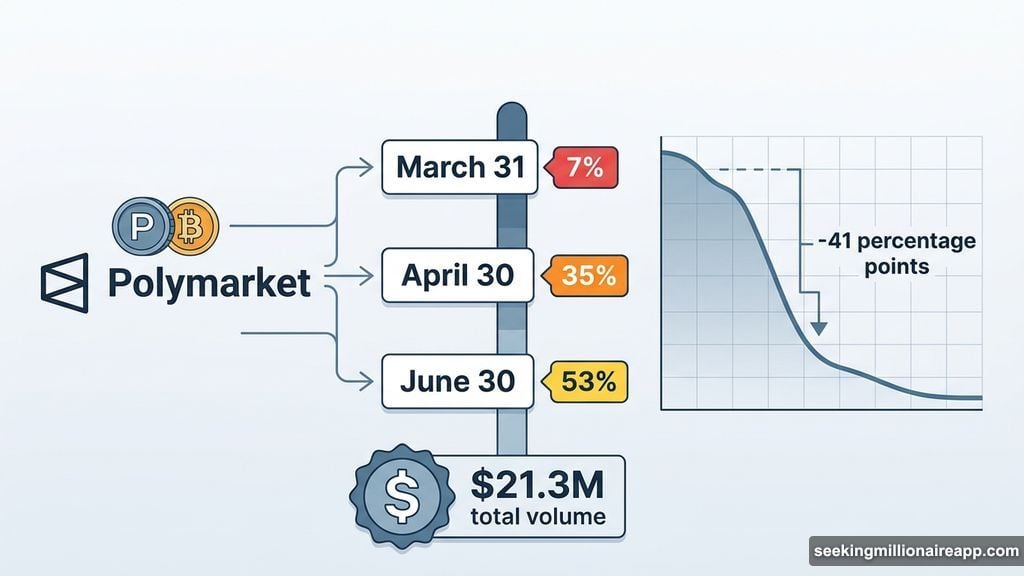
On Polymarket, the largest crypto-native prediction market, traders give just 7% odds of a US-Iran ceasefire by March 31. That number is brutal. The April 30 contract sits at 35% — down a staggering 41 percentage points from its peak. Even the June 30 deadline only carries a 53% probability.
So far, the market has pulled in $21.3 million in total trading volume since the war began on February 28. That’s serious money behind a pretty dark forecast.
Professional Forecasters Agree With the Crowd
Good Judgment’s Superforecasters — a network with deep roots in US intelligence community research — are telling the same story. Their latest model gives a 43% chance that no ceasefire arrives before May 15. That figure climbed 10 percentage points in a single week.
The April 17 to May 14 window jumped 7 points, now sitting at 30%. Meanwhile, odds of a ceasefire before March 26 collapsed to just 2%.
Two completely different forecasting systems. One consistent message. The White House’s projection of a four-to-six-week conflict? Neither prediction markets nor professional forecasters are buying it.
Powell Raises Inflation Forecast, Blames Oil
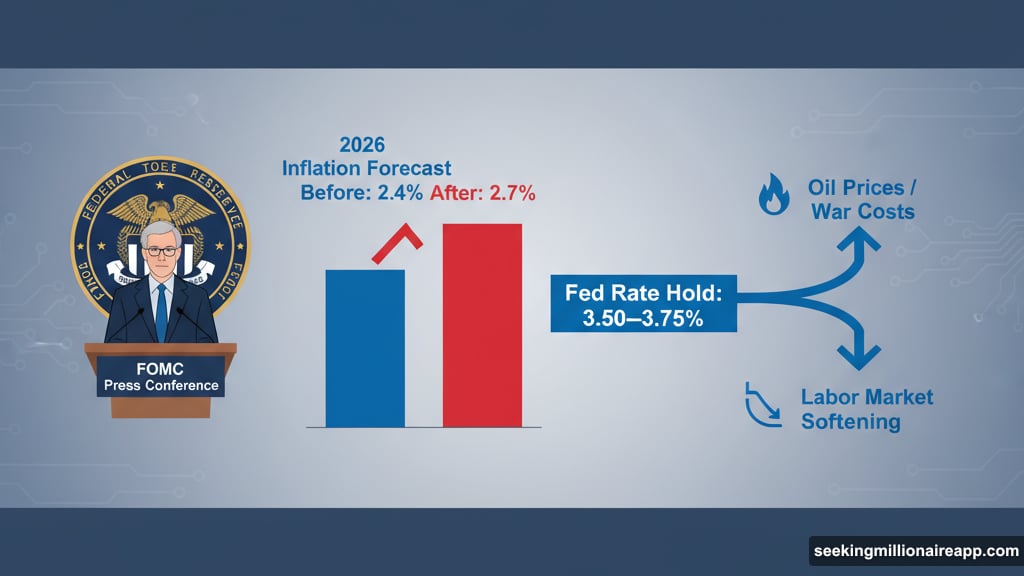
The Federal Reserve held rates steady at 3.50–3.75% on Wednesday. But Fed Chair Jerome Powell raised the 2026 inflation forecast from 2.4% to 2.7%. Rising oil prices from the Middle East conflict, he said, “for sure showed up” in policymakers’ updated numbers.
Core PCE inflation currently sits at 3.0%. Tariffs account for roughly half to three-quarters of a percentage point of that. And now war-driven energy costs are piling on top.
Powell kept repeating one phrase: “Nobody knows.” Several FOMC members reportedly felt this was a good meeting to skip economic projections entirely. That tells you something about the uncertainty level in the room.
The Fed’s Impossible Balancing Act
Here’s the bind the Fed is in right now. Inflation risk is pushing toward higher rates. A softening labor market is pushing toward cuts. Those two forces are pulling in opposite directions, and the war just made both worse.
Powell also addressed a key question head-on. Would the Fed simply “look through” the energy shock and hold steady? His answer was cautious. The standard approach assumes inflation expectations stay anchored. But he acknowledged that five consecutive years above target make that assumption shakier.
He did dismiss comparisons to 1970s stagflation, calling current conditions far milder. Still, the Fed’s options are shrinking the longer this war continues.
Oil Surges, Bitcoin Drops, Asian Markets Slide
Brent crude hit $108.78 per barrel on March 18 — up roughly $38 from a year ago. The International Energy Agency reported that Middle East disruptions cut global oil supply by 8 million barrels per day in March. That’s an enormous disruption.
Markets reacted fast. Bitcoin dropped nearly 4% to $71,017 after the FOMC meeting, extending what’s become a consistent pattern of post-Fed selloffs. The Nasdaq closed at its session low, down 1.5%. US Treasury two-year yields rose six basis points to 3.73%, while traders priced in less than one full rate cut for all of 2026.
Asian markets didn’t escape either. Japan’s Nikkei 225 fell 2.80% and South Korea’s KOSPI dropped 2.95% on Thursday. Both countries are heavily dependent on energy imports, which makes them especially vulnerable when oil prices stay this elevated for this long.
What Crypto Investors Should Watch Next
The next FOMC meeting is six weeks away. Powell said the committee expects to “learn a lot” in that window — which is Fed-speak for “we’re watching this war very closely.”
For crypto markets, the math isn’t complicated. A prolonged conflict means sustained high oil prices. High oil prices mean stickier inflation. Sticky inflation means fewer rate cuts. Fewer rate cuts mean continued headwinds for risk assets like Bitcoin.
The only thing that changes that chain quickly is a ceasefire signal. And right now, those signals aren’t coming. Iran’s Foreign Minister Abbas Araghchi told CBS on March 15 that Tehran has “never asked for a ceasefire.” Until that posture shifts, prediction markets are telling investors to settle in for a long wait.
The numbers are speaking. Whether the markets are ready to listen is another question entirely.