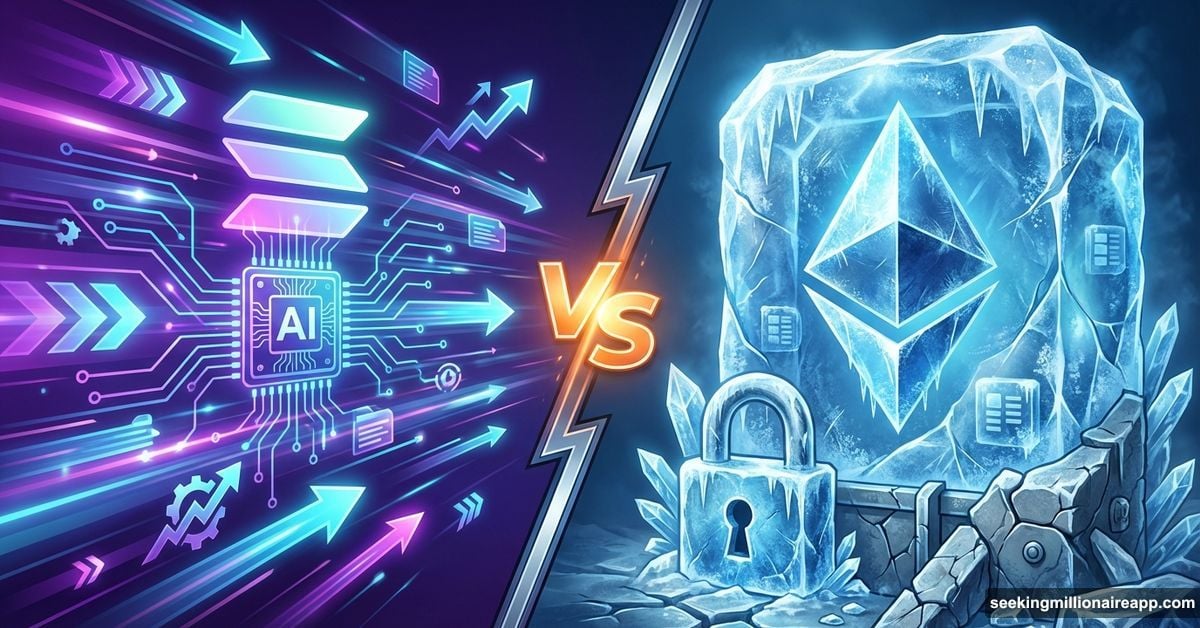
Anatoly Yakovenko doesn’t buy Ethereum’s endgame. Instead, the Solana co-founder argues that blockchain networks must evolve forever or die trying.
His January 17 post on X sparked debate about what crypto’s future actually looks like. So while Vitalik Buterin wants Ethereum to eventually “ossify” into a permanent, unchanging protocol, Yakovenko sees that vision as a death sentence. In his view, blockchains that stop adapting become irrelevant fast.
This isn’t just philosophical posturing. It represents two fundamentally different strategies for building the infrastructure of Web3.
Networks That Stop Changing Die
Yakovenko’s logic is straightforward. Blockchains exist to serve developers and users. Plus, those needs constantly shift as technology advances and markets evolve.
“To not die requires to always be useful. So the primary goal of protocol changes should be to solve a dev or user problem,” he wrote. However, he acknowledged that saying no to most proposed changes is necessary. Not every feature request deserves implementation.
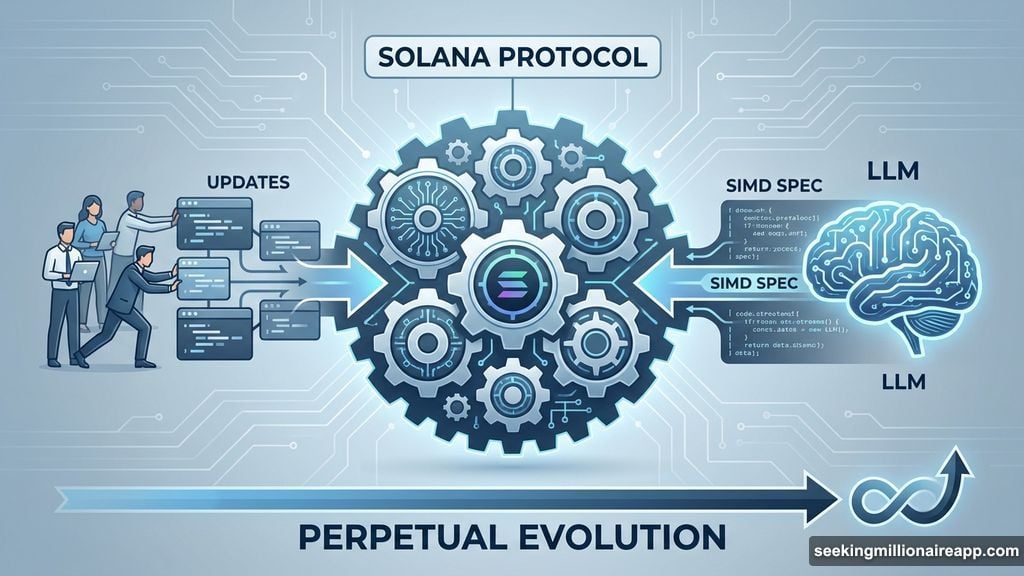
But the core principle remains firm. Solana must iterate perpetually to maintain its relevance. Moreover, this approach requires building a network that doesn’t depend on any single team or individual to drive improvements.
That’s where things get interesting. Because Yakovenko isn’t just talking about human developers pushing updates forever.
AI Could Write Protocol Upgrades Soon
Here’s where Yakovenko’s vision gets wild. He believes AI systems, specifically large language models, will eventually generate and verify protocol specifications independently.
“LLM can generate a SIMD spec so tight that LLM can verify it’s complete and unambiguous and implement it,” he claimed. SIMD refers to Solana Improvement Documents, the network’s formal proposal system.
In this scenario, artificial intelligence handles the technical heavy lifting. Then human governance focuses solely on reaching consensus and allowing sufficient testnet validation. That’s it.
The implications are massive. If AI can reliably write blockchain code, development cycles could shrink from months to days. Plus, the network might self-optimize faster than any human team could manage.
Of course, that raises obvious questions about security and control. Yet Yakovenko seems confident this represents Solana’s path forward.
Buterin Wants Ethereum Locked Forever
Contrast that with Ethereum’s roadmap. Vitalik Buterin recently introduced what he calls the “walkaway test.” This milestone defines the point where Ethereum becomes truly self-sustaining.
Under Buterin’s vision, Ethereum will eventually “ossify.” Once the network achieves quantum resistance, sufficient scalability, and a lasting state architecture, it stops changing. Then the protocol runs permanently without its founding developers.
Buterin admits Ethereum needs continued upgrades in the near term. However, he emphasizes that the endgame involves locking the protocol into its final form. After that, Ethereum’s value derives from permanence and reliability rather than new features.
This philosophy positions Ethereum as digital bedrock. A settlement layer that prioritizes security and immutability above rapid innovation. In theory, that makes it perfect for financial infrastructure that demands stability.
But Yakovenko sees a fatal flaw in that thinking.
Two Competing Visions for Crypto’s Future
These divergent strategies reveal fundamentally different bets about what crypto becomes.
Ethereum’s approach makes sense if you believe blockchains should function like internet protocols. TCP/IP doesn’t change often because stability matters more than features. Similarly, Ethereum aims to become unchanging infrastructure that everything else builds on top of.
Solana’s approach makes sense if you believe blockchains compete like technology platforms. Apple’s iOS gets constant updates because user expectations evolve. So Solana embraces rapid iteration to capture market share in a competitive environment.
Neither vision is obviously wrong. In fact, both might succeed serving different use cases.
Ethereum could dominate high-value settlement where predictability trumps performance. Meanwhile, Solana might win applications requiring speed and constant technical improvements.
The Real Risk Nobody Mentions
Here’s what concerns me about both approaches. Yakovenko’s perpetual iteration model sounds great until something breaks catastrophically. Fast-moving development increases the risk of bugs, exploits, and unintended consequences.
Remember, Solana has suffered multiple network outages since launch. Some lasted hours. Others disrupted major trading events. Constant upgrades contributed to that instability.
Conversely, Buterin’s ossification dream assumes Ethereum reaches technical perfection before locking down. But what if unforeseen challenges emerge after ossification? Then the network can’t adapt without breaking its core value proposition.
Both strategies carry real risks that enthusiasts downplay.
Decentralization Claims Need Scrutiny
Yakovenko emphasized that Solana’s future iterations should come from “a diverse, decentralized community of contributors.” That sounds ideal. But current reality tells a different story.
Solana Labs still drives most major protocol development. Sure, outside contributors exist. However, the core engineering team maintains enormous influence over the network’s direction.
Similarly, Ethereum faces centralization concerns despite its larger developer ecosystem. A small group of researchers and developers shapes consensus on contentious upgrades.
True decentralized governance remains elusive for both networks. So pledges about community-driven development often ring hollow when key decisions still flow through narrow channels.
Performance Versus Stability Tradeoff
Ultimately, this debate boils down to fundamental tradeoffs. Solana prioritizes performance and aggressive feature development. That attracts developers building consumer applications requiring speed.
Ethereum prioritizes security and eventual stability. That attracts institutions building financial infrastructure requiring reliability.
Both blockchains will likely coexist serving different markets. Yet their philosophical differences highlight broader questions facing the entire crypto industry.
Should blockchains evolve like technology platforms that constantly improve? Or should they ossify like internet protocols that rarely change?
The answer probably depends on what you’re building and who you’re serving. There’s no universal solution that fits every use case.
Where This Leads
Yakovenko’s AI-assisted development vision sounds futuristic. But it’s coming faster than most people expect. Large language models already generate decent code. Plus, they’re improving rapidly.
If AI truly can write verified protocol specifications, blockchain development transforms completely. However, that also concentrates power in whoever controls the AI systems generating those specs.
Meanwhile, Buterin’s ossification timeline stretches years into the future. Ethereum still needs major upgrades for quantum resistance and scalability. So the network won’t lock down anytime soon.
That gives Solana time to prove perpetual iteration works. And it gives Ethereum time to demonstrate that methodical, stability-focused development attracts lasting value.
Both experiments deserve watching closely. Because the winner of this philosophical debate shapes crypto’s long-term trajectory.
Choose your blockchain based on what matters for your use case. Speed and innovation? Consider Solana. Stability and predictability? Ethereum makes sense. Just understand the tradeoffs you’re accepting either way.