
Tether went big on gold. It poached elite traders from one of the world’s top bullion banks. Then, just months later, it let them both go.
The sudden reversal is raising eyebrows across both the crypto and commodities worlds. And it tells an interesting story about what happens when a crypto-native company tries to play in a very old, very relationship-driven market.
The Big Ambition Behind the Hires
Tether CEO Paolo Ardoino wasn’t shy about what he wanted. He told Bloomberg the company needed to build the best gold trading floor in the world. That’s a bold statement for a stablecoin issuer, but Tether had the reserves to back it up.
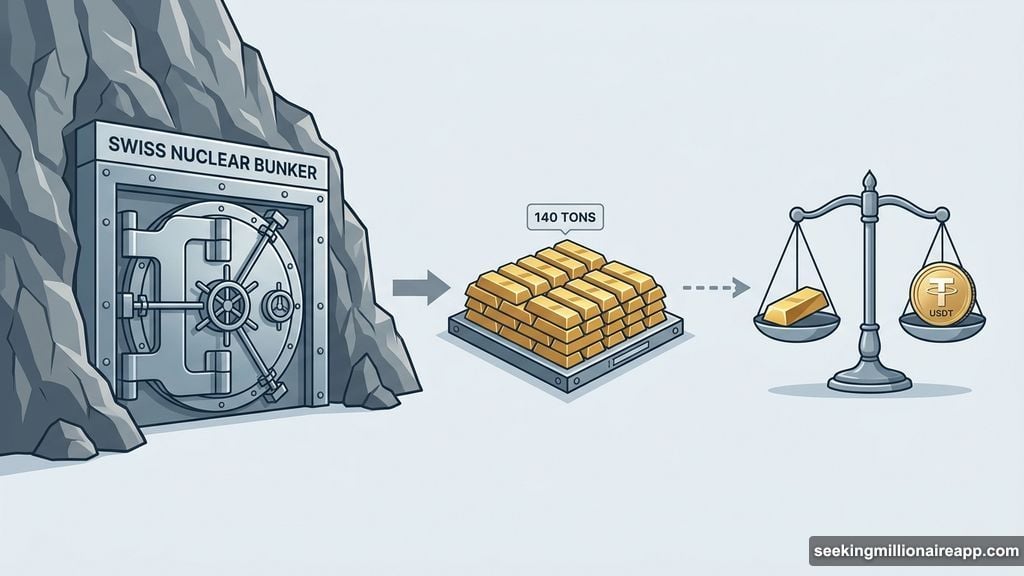
The company holds roughly 140 tons of physical gold, stored in a former Cold War nuclear bunker in Switzerland. That stash is worth about $24 billion. Outside of central banks, exchange-traded funds, and commercial banks, almost nobody holds more.
So when Tether recruited Vincent Domien, HSBC’s former global head of metals trading and a board member of the London Bullion Market Association (LBMA), it felt like a serious move. Mathew O’Neill, who ran precious metals origination across Europe, the Middle East, and Africa at HSBC, followed him to Tether in late 2025. Together, they looked like the foundation of something genuinely ambitious.
Gold Buying on a Central Bank Scale
The hiring spree made more sense when you looked at Tether’s recent gold activity. The company bought over 70 tons of gold last year alone, outpacing nearly every central bank on the planet except Poland. That’s not a passive reserve strategy. That’s active accumulation.
Tether also signaled it planned to trade its gold reserves, specifically to capture arbitrage between futures and physical prices. That kind of active trading requires exactly the type of expertise Domien and O’Neill brought from HSBC. The plan seemed logical, even well-constructed.
But the physical gold market isn’t like crypto. It runs on decades-old relationships between banks, refiners, miners, and dealers. Trust is built slowly. Deals flow through networks that took careers to develop.
When Crypto Culture Meets Commodities Reality
Bridging that gap has proven harder than expected. Tether has not publicly explained the departures. Neither Domien nor O’Neill has commented publicly. The silence makes it difficult to know whether this was a strategic pivot, a culture clash, or something else entirely.
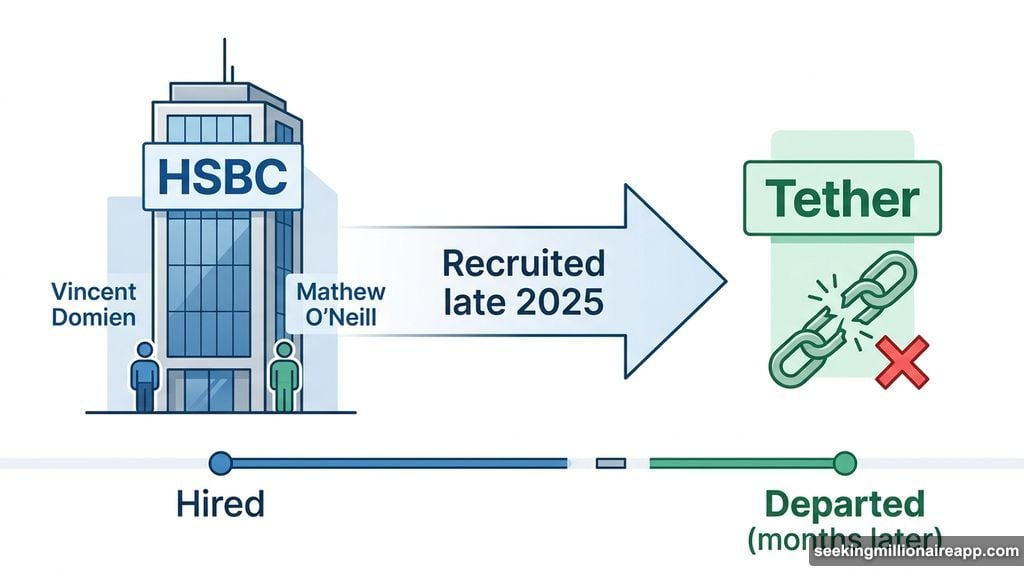
Still, the pattern speaks for itself. A crypto company with enormous ambitions recruited two of the most credentialed traders in the London bullion market. Months later, both are gone.
That timeline suggests the integration between Tether’s crypto treasury approach and institutional bullion trading hit some real friction. Whether that’s about operational differences, strategic disagreements, or simply how a decentralized organization handles traditional finance talent remains unclear.
What Tether Still Controls
Despite the shakeup, Tether isn’t walking away from gold entirely. The company continues to hold its substantial physical reserves and still issues Tether Gold (XAUT), which commands roughly 60% of the gold-backed stablecoin market. That’s a dominant position in a niche that barely existed a few years ago.
The real question now is what Tether does next with its gold desk. Does it replace Domien and O’Neill with similar institutional talent? Does it restructure the trading operation around a different model? Or does it quietly scale back the ambition of competing directly with JPMorgan and HSBC in bullion trading?
The answer to that question will reveal a lot about how serious Ardoino remains about his vision of Tether becoming a sovereign-scale gold power. Right now, the scoreboard shows two big hires and two quick exits. That’s not the start anyone envisioned.