The ongoing US-Iran conflict has been running for just over a month. And quietly, the bill is landing in every American’s pocket.
New estimates put the total cost at somewhere between $30 billion and $45 billion over roughly 34 days. Break that down across the US population and you’re looking at about $2.50 to $3.80 per person, per day. The central estimate sits right around $3 daily.
That might not sound dramatic. But multiply it out, and the numbers get uncomfortable fast.
Military Spending Drives the Biggest Bill
The largest single cost is direct military spending. Early figures suggest the US has already committed tens of billions to operations, making it the dominant item on the tab.
This is government spending, so it doesn’t show up on your grocery receipt. But it absolutely affects your finances. Military costs of this scale add to the national debt, push up borrowing, and eventually filter through to interest rates and taxes.
So even if you never notice it directly, you’re still paying.
Gas Prices Are the Most Visible Punch
Here’s where everyday Americans really feel it. Oil prices jumped hard when the conflict started.
Just over a month ago, crude oil was trading around $79 per barrel. It’s now sitting above $110. That’s a roughly 40% surge in a matter of weeks, driven almost entirely by supply fears and disruptions around the Strait of Hormuz, one of the world’s most critical shipping chokepoints.
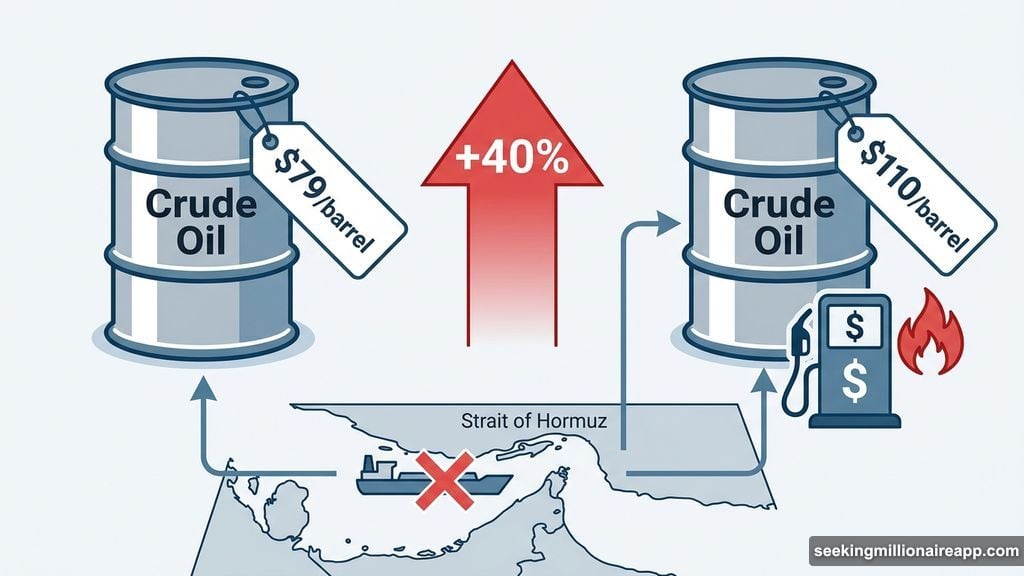
The result? Gasoline prices climbed sharply at pumps across the country. That alone has added an estimated $4 billion to $6 billion in extra fuel costs for American households. And unlike government spending, this one hits immediately. You see it every time you fill up.
Inflation Is Starting to Spread
Oil doesn’t just power your car. It powers everything.
When crude prices rise, transport costs go up. That affects the price of food, manufactured goods, and pretty much anything that gets shipped anywhere. So the inflation spillover from higher oil is estimated at another $2 billion to $4 billion on top of direct fuel costs.
Mortgage rates have also nudged higher alongside rising borrowing costs. That’s quietly making homeownership more expensive and squeezing household budgets further. None of this is dramatic on a single day. But it compounds.
The Cost Nobody’s Talking About
The direct costs are one thing. The hidden cost is another story entirely.
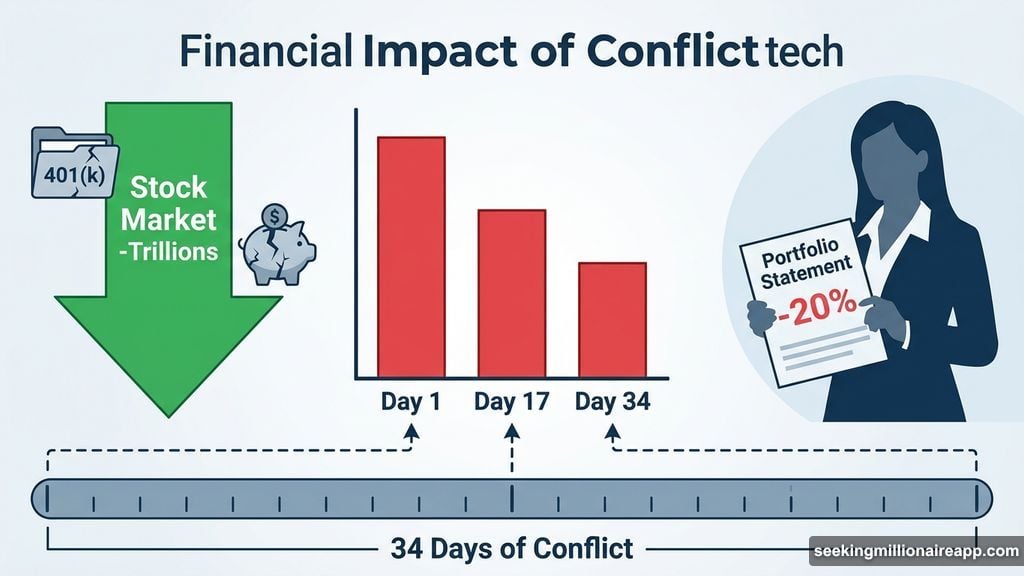
US stock markets have lost trillions in value since the conflict began. That doesn’t show up in the daily breakdown the same way fuel costs do. But for anyone with a 401(k), a retirement account, or any market-linked savings, the damage is very real. It just sits quietly in your account statement rather than your bank balance.
This is the part of the war economy that’s easy to ignore until you actually look at your portfolio.
The Simple Breakdown Over 34 Days
Here’s how the estimated $30 billion to $45 billion total breaks down:
- Military spending: $23 billion to $34 billion
- Higher fuel costs: $4 billion to $6 billion
- Inflation spillover: $2 billion to $4 billion
Together, those three categories account for the full range of current estimates.
The Bigger Risk Is What Comes Next
Three dollars a day sounds manageable. The risk is that it doesn’t stay there.
If oil continues climbing past $110 per barrel, fuel costs will accelerate. If the conflict expands geographically or pulls in additional players, military spending will jump again. And if inflation builds momentum from here, the Federal Reserve faces pressure to raise interest rates, which makes mortgages, car loans, and credit cards more expensive for everyone.
That’s the scenario economists are watching most closely. Not the current cost, but the trajectory.
Right now, Americans are absorbing a modest daily financial hit spread across higher prices and government spending. Most people won’t notice it in isolation. But if oil keeps rising and markets stay rattled, the cumulative impact on household finances could become much harder to ignore. The war’s price tag so far is a footnote. Whether it stays that way depends entirely on what happens next.