AI agents can now trade, stake, and move funds on their own. The question was always: which wallet would they use? Trust Wallet just answered that question loudly.
The company behind one of crypto’s most popular self-custody platforms launched the Trust Wallet Agent Kit this week. It’s a developer toolkit that lets AI agents carry out real wallet-connected actions — swaps, trades, DeFi interactions — all within boundaries set by the user. Think of it as giving an AI assistant a company credit card with a spending limit baked in.
This launch builds on a developer portal Trust Wallet released just a week earlier, which gave AI agents read-only access to crypto data across more than 100 blockchains. Now, agents can actually do things, not just look.
Claude Code Skills Arrived First
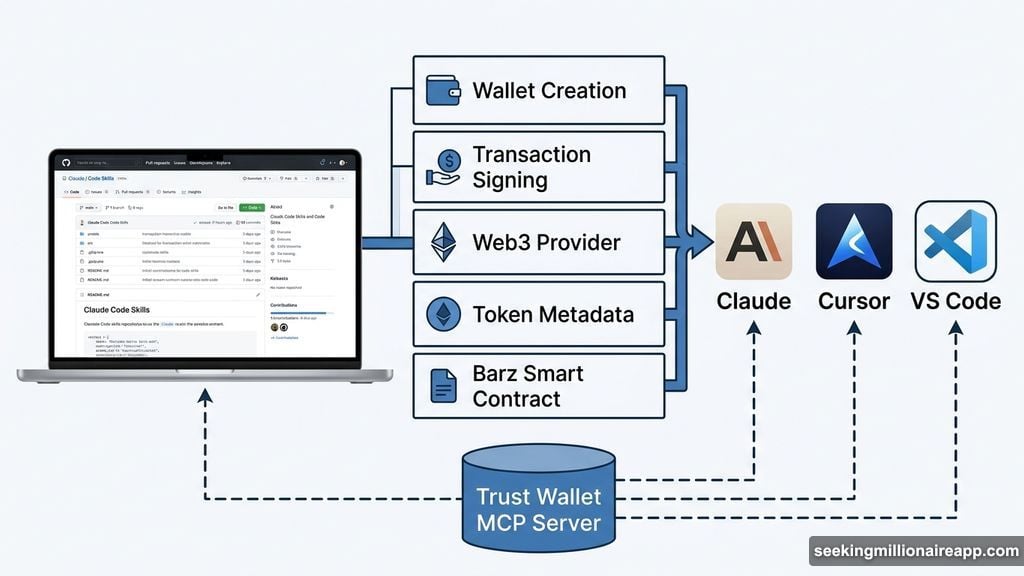
The groundwork started back in February. Trust Wallet quietly released a set of AI-focused developer tools, including something called Claude Code Skills.
It’s an open-source skills marketplace on GitHub that plugs directly into Anthropic’s Claude coding assistant. Instead of developers manually feeding Trust Wallet documentation into AI tools, the system already knows how everything works. Five skill modules launched at the start, covering wallet creation, transaction signing across 100-plus blockchains, Web3 provider integrations for Ethereum, Solana, Cosmos, and Bitcoin, token metadata management, Trust Wallet’s smart contract wallet called Barz, and utilities like WalletConnect integrations.
Trust Wallet also launched an MCP server alongside this. It connects the company’s entire documentation library directly into popular AI coding environments like Claude, Cursor, and VS Code. The goal is simple: make building AI-powered wallet applications faster and less painful.
The Agent Kit is the next step up from all of that. It moves beyond documentation and code assistance into actual on-chain execution.
Two Ways to Connect AI to Your Crypto
The Agent Kit gives developers two distinct models to work with, and they serve pretty different needs.
The first model creates a dedicated wallet built specifically for AI agent activity. Users define permissions and limits in advance — things like dollar-cost averaging rules, price alerts, or limit-based trading strategies. The AI agent then operates within those boundaries on its own, executing trades or interacting with DeFi protocols without needing approval for every single action.
It really is like handing an employee a payment card with a pre-set monthly limit. The agent moves freely within that space, but you control the rules from the start.
This model works across a broad range of blockchain ecosystems. Trust Wallet lists EVM networks, Solana, Bitcoin, TON, Cosmos, Tron, NEAR, Aptos, and Sui as supported chains. So this isn’t limited to Ethereum — it covers most of the major on-chain environments where DeFi actually happens.
AI Assistance Without Giving Up Control
The second model takes a more cautious approach. And honestly, for most regular users, this is probably the more appealing option.
Instead of creating a separate agent wallet, the AI connects to your existing Trust Wallet through WalletConnect. It can propose transactions and suggest actions, but you keep final approval for everything. Nothing moves without your signature.
This approach removes one of the biggest friction points in AI-powered crypto products. Most competing tools ask users to transfer funds into a new system before automation can even start. That’s a big ask for anyone who cares about keeping custody of their assets.
Here, custody stays with you the entire time. The AI handles the thinking and the suggestions. You handle the final call.
DeFi Automation Without the Manual Work
So what does this actually look like in practice? Imagine you want to automatically compound your staking rewards every week. Or rebalance your portfolio when a certain token hits a price threshold. Or execute a series of trades based on signals you’ve defined in advance.
Normally, all of that means manually signing transaction after transaction. With the Agent Kit, you set the rules once and the AI handles the execution within those limits.
The wallet becomes a signing hub. You define the goals. The agent handles the repetitive work. That same model could extend further — managing liquidity positions, running limit orders across multiple chains, or handling routine cross-chain transfers without constant manual input.
An Agent Marketplace Is Coming
Trust Wallet is also pointing toward a bigger picture. The company mentioned an Agent Marketplace expected to arrive in roughly two months.
The idea is that developers could publish reusable agent strategies and automated bots, which users could then discover and deploy directly from inside the wallet. It’s still early on the roadmap, but the direction is clear. Trust Wallet wants the wallet itself to become a place where users browse, install, and run AI agents the same way they’d install an app.
For crypto wallets, that’s a meaningful shift. Wallets started as simple key storage tools. They evolved into gateways for DeFi, staking, and cross-chain activity. Adding a layer of AI automation on top of that starts to look less like a wallet and more like a personal financial operating system — one where you define the strategy and agents handle the execution.
Whether users embrace that vision depends a lot on trust. Specifically, whether they believe the permission systems are solid enough to hand any level of control to an automated agent. Trust Wallet’s approach of keeping humans in the loop — especially with the WalletConnect model — suggests the company is thinking carefully about that balance. But real-world testing across complex DeFi environments will tell the full story.
The Agent Kit is live now. The Agent Marketplace follows in about two months. For developers building AI-powered crypto applications, the timing to start experimenting is right now.