
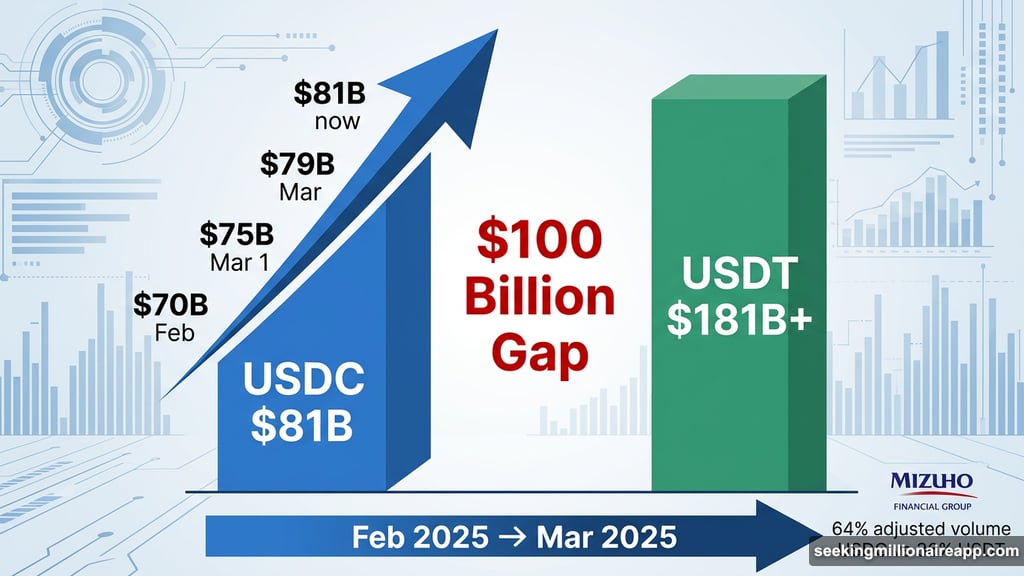
The stablecoin war just got a lot more interesting. USDC still trails Tether by over $100 billion in market cap, but it’s quietly winning the countries that matter most to regulators and institutional investors.
And that shift is happening faster than most people expected.
USDC’s Supply Surge Caught Everyone Off Guard
Circle’s USDC hit $81 billion in circulating supply after a remarkable run. It jumped from just over $70 billion in early February to $75 billion by March 1, then blew past $79 billion shortly after. That’s one of the fastest supply expansions any major stablecoin has seen.
But the really striking number came from Mizuho Financial Group’s March 13 research note. USDC processed about $2.2 trillion in adjusted transaction volume year-to-date, compared with $1.3 trillion for USDT. That gives USDC roughly 64% of the combined adjusted volume between the two stablecoins.
To understand how wild that is, consider the history. From 2019 through 2025, USDT consistently led on volume. USDC averaged only about 30% of combined volume during that entire stretch. So flipping to 64% in a matter of months is a significant reversal.
Mizuho analysts Dan Dolev and Alexander Jenkins define adjusted volume as transfers involving centralized exchanges, decentralized exchanges, and other real-value entities. In other words, it strips out automated or repetitive activity that inflates raw transaction counts. They argue this metric matters more than market cap when predicting the long-term stablecoin winner.
Country-Level Ownership Tells a Fragmented Story
BVNK’s Stablecoin Utility Report 2026 adds an important layer to this picture. Compiled with YouGov across 4,658 respondents in 15 countries, the dataset reveals that the global stablecoin race has split into distinct regional battles.
Tether still dominates in raw numbers. Nigeria leads all countries with 59% USDT ownership versus 48% for USDC, reflecting deep roots in economies dealing with volatile local currencies. USDT also leads in India, the Philippines, Singapore, Thailand, Argentina, France, and the United Kingdom.
But five countries tell a different story entirely.
Colombia shows 29% USDC ownership versus 25% for USDT. South Africa registers 29% versus 23%. Germany comes in at 17% versus 15%, Brazil at 16% versus 14%, and the United States at 26% versus 22%. In each case, the supposedly smaller stablecoin is actually winning on the ground.
Leon Waidmann, Head of Research at Lisk, highlighted this pattern clearly. “USDT vs USDC ownership by country. Ranked… USDC is catching up. In Colombia, South Africa, the US, Germany, and Brazil, USDC ownership actually exceeds USDT. The regulated stablecoin is gaining ground,” he wrote.
MiCA Compliance Is Reshaping the Map
The geographic pattern isn’t random. It traces almost perfectly along regulatory lines.
Circle, which issues USDC, holds compliance licenses under Europe’s Markets in Crypto-Assets (MiCA) regulation. It also aligns with the US GENIUS Act framework. Both of those regulatory structures give institutions and cautious retail users a clear reason to prefer USDC in markets where compliance matters.
Tether took a different path. It opted out of MiCA compliance and focused growth on Asia and other non-Western markets. That strategy makes sense given USDT’s massive head start in those regions. But it also means USDT may face structural headwinds in regulated markets going forward.
The result is a stablecoin market effectively sorting itself by jurisdiction. Regulated markets trend toward USDC. Emerging markets and high-volatility economies trend toward USDT. Together, the two stablecoins still account for approximately 93% of total stablecoin market capitalization, according to TRM Labs. But the dividing lines between their territories are sharpening.
Capital Flight Added Fuel to the Fire
Part of USDC’s recent supply surge has a geopolitical dimension that most coverage missed entirely.
Dubai-based analyst Rami Al-Hashimi attributed a meaningful portion of recent demand to capital flight from the UAE. Over-the-counter desks in Dubai reportedly struggled to keep up with USDC orders as Dubai’s real estate market declined sharply. The DFM Real Estate Index fell roughly 31% from a recent peak of around 16,800 to about 11,516, according to TradingView data.
Token Metrics noted something particularly striking about this trend. When investors in oil-rich economies move into USDC rather than traditional dollar bank accounts, it signals that digital dollars are starting to compete directly with physical dollars. That’s a different kind of adoption than the crypto-trading use cases that drove early stablecoin growth.
The broader stablecoin market reached a record $315 billion as of mid-March, reflecting growing institutional demand across both trading and non-trading applications. Mizuho raised its Circle stock price target from $100 to $120, citing expanding USDC use cases in prediction markets and agentic commerce as key drivers.
What $184 Billion in Market Cap Actually Means
Tether’s dominance isn’t going anywhere fast. A $184 billion market cap is a staggering number. USDC would need to more than double its current supply just to match USDT’s existing base. That kind of gap doesn’t close in months.
But market cap and transaction volume tell different stories. USDC processing 64% of combined adjusted volume despite holding less than half the market cap suggests its dollars are moving more actively. The same dollar is doing more work on USDC’s rails than on USDT’s.
That efficiency argument, combined with regulatory advantages in Western markets and emerging institutional adoption driven by capital-flight dynamics, gives Circle a credible path to sustained relevance even without catching Tether on supply.
The USDC versus USDT competition no longer looks like a single global race. It looks like dozens of country-level contests happening simultaneously, each influenced by local regulation, currency volatility, and institutional preferences. Right now, the early data from 2026 suggests USDC is winning the regulated markets while USDT holds its grip on the rest. Whether that split deepens or closes will define the stablecoin landscape for years to come.