
Most people picture Ethereum as this decentralized, widely distributed network where no single player holds too much power. The reality, according to fresh on-chain data, looks quite different.
Arkham Intelligence just published a detailed breakdown of the largest Ethereum holders in 2026. The findings draw from the Arkham Intel Platform and cover everyone from giant exchanges to a guy in Estonia who technically owns half a billion dollars in ETH but can’t actually touch it. Spoiler: the distribution of ETH is far more concentrated than most people realize.
The ETH2 Beacon Contract Holds Nearly Two-Thirds of All ETH
Before we even get to the banks and exchanges, one number absolutely dominates the list.
The ETH2 Beacon Deposit Contract holds over 82 million ETH. At current prices, that’s roughly $169 billion. Even more striking, that single contract represents about 66% of the total ETH supply, locked up by validators who are actively securing the network.
So when people talk about who “owns” Ethereum, the honest answer is that most of it is busy holding the whole system together. That’s either reassuring or alarming depending on your perspective.
Coinbase, Binance, and BlackRock Dominate Exchange and Institutional Holdings
Among exchanges, Coinbase leads the pack with 4.2 million ETH, worth around $8.6 billion. Binance follows closely with 3.6 million ETH ($7.3 billion). South Korean exchange Upbit rounds out the top three at 1.7 million ETH.
Worth noting: these holdings are custodial. The exchanges hold this ETH on behalf of their users for trading, withdrawals, and staking services. So it’s not like Coinbase’s executives are sitting on a personal treasure chest. Still, it does mean enormous amounts of ETH flow through just a handful of platforms.
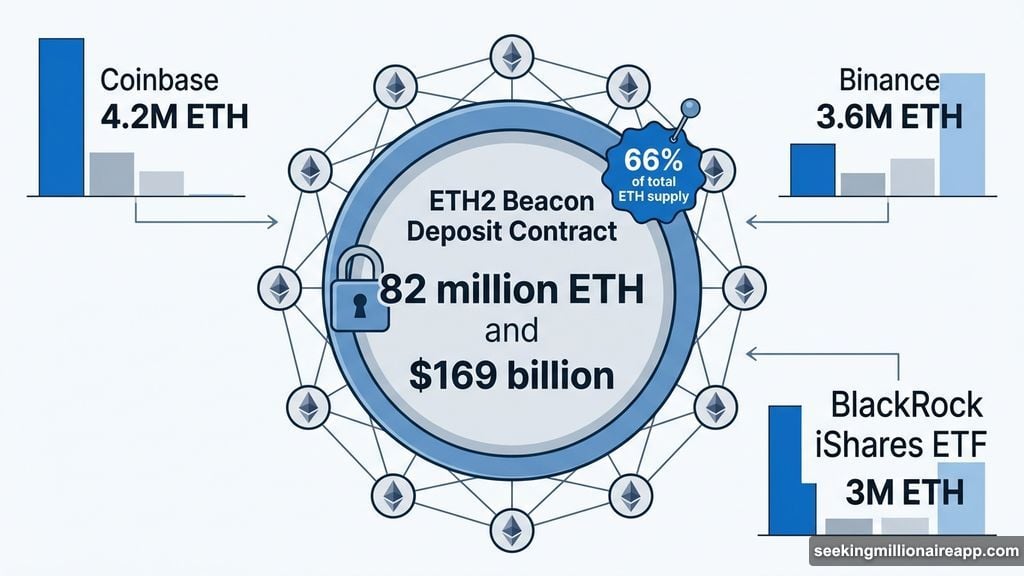
On the institutional side, BlackRock holds over 3 million ETH, valued at roughly $6 billion, through its iShares Ethereum Trust ETF. That’s a staggering number for a Wall Street giant that not long ago was deeply skeptical of crypto assets.
Treasury company Bitmine also declared 4.7 million ETH in total holdings, though Arkham has only verified 914,000 ETH of that figure on-chain. The company has made no secret of its ambition: it wants to accumulate 5% of the entire ETH supply.
The Estonian Investor Who Lost $530 Million Worth of ETH
Now here’s the story that genuinely stopped me mid-read.
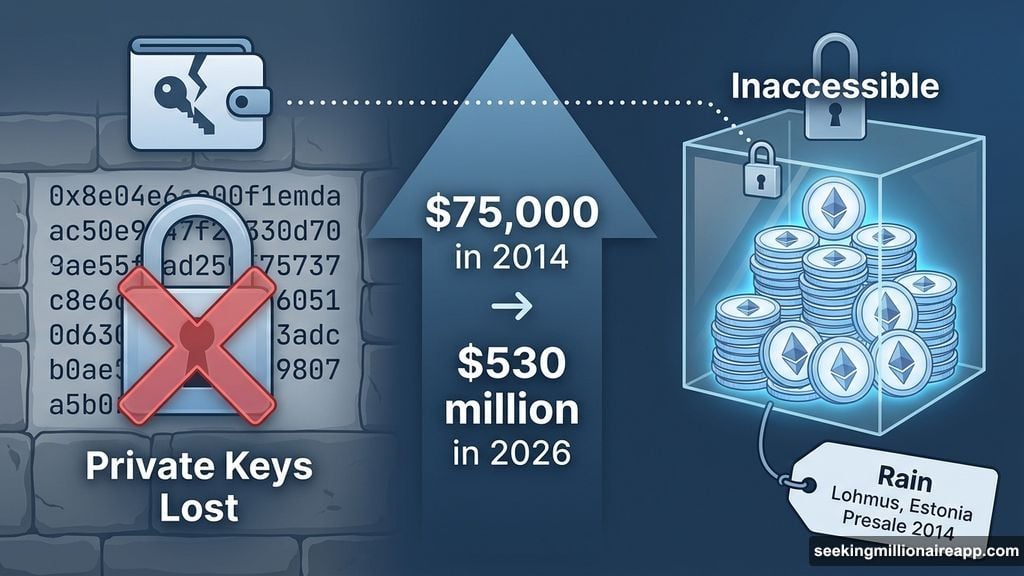
Estonian pre-sale investor Rain Lohmus technically holds the most ETH of any individual on the list: 250,000 tokens currently worth around $530 million. He bought them back in 2014 for just $75,000 during Ethereum’s original presale.
The catch? He lost access to his private keys. That ETH is sitting there on-chain, perfectly visible, completely inaccessible. It’s the crypto equivalent of finding out you won the lottery but the ticket dissolved in the wash.
Vitalik Buterin, Ethereum’s co-founder, holds the title of largest individual holder with funds he can actually use. He controls 224,000 ETH, worth about $480 million.
The Ethereum Foundation Stops Selling and Starts Staking
One of the more meaningful shifts in this report involves the Ethereum Foundation itself.
For years, the Foundation funded its operations by periodically selling ETH from its treasury. That practice drew real criticism from the community. Every time the Foundation sold, it created downward price pressure, which frustrated long-term holders who felt the Foundation was essentially cashing out while they held.
The Foundation announced a change of direction back in February: it would stake 70,000 ETH from its treasury instead of selling. Staking rewards would then fund research, ecosystem grants, and protocol development.
Arkham reported that the Foundation recently staked an additional $46.64 million worth of ETH in a single day, its largest single-day deployment yet. That brings the Foundation’s total staked amount to approximately $96.59 million, or about $97 million.
It’s a meaningful signal. Instead of converting ETH to cash, the Foundation is now participating in network security while earning yield. The community seems considerably happier about this arrangement.
What This All Means for Ethereum
The picture that emerges from Arkham’s data is one of increasing concentration, but not necessarily in a sinister way.
Staking contracts, institutional ETFs, and exchange custody accounts now control the overwhelming majority of ETH. Plus, with the Ethereum Foundation joining the staking cohort, even more supply is getting locked away from liquid markets. Less liquid ETH generally means less potential sell pressure, which long-term holders tend to view as a good thing.
But it’s worth asking honest questions. A network where 66% of supply is locked in one contract, and much of the rest sits with Coinbase, Binance, and BlackRock, looks different from the decentralized ideal many early adopters signed up for. Whether that concentration creates new risks is a conversation the Ethereum community will keep having.
For now, the data is clear. Ethereum’s biggest holders aren’t anonymous cypherpunks. They’re staking contracts, regulated exchanges, Wall Street ETFs, and at least one very frustrated Estonian investor staring at a fortune he can’t reach.