
The crypto market just served up a brutal reminder about leverage. Over $422 million in positions got liquidated in a single 24-hour stretch, and the bears who bet on further downside got hit hardest in the final hours.
But here’s what made this particularly painful. Both sides of the trade got wrecked. Bulls lost money first. Then the bears got squeezed when prices bounced back.
Short Sellers Got Caught Flat-Footed
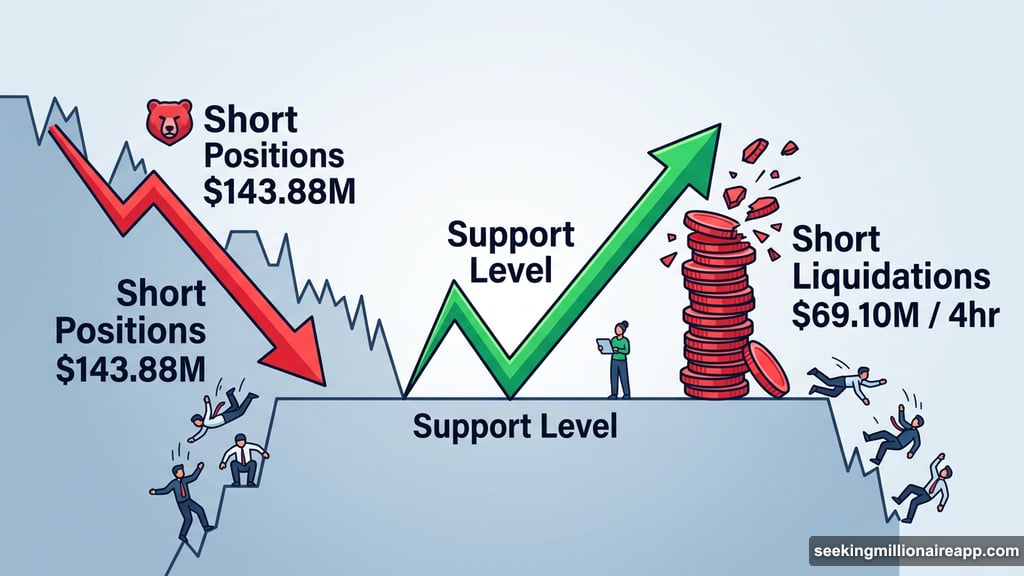
The numbers tell the story clearly. In just the most recent four-hour window, short liquidations hit $69.10 million. Long liquidations during that same stretch? Only $19.96 million.
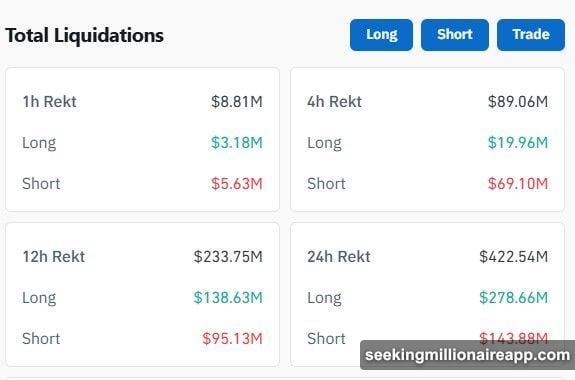
That gap is significant. It shows that bearish traders who expected prices to keep falling got caught completely off guard by the sudden bounce. Bitcoin and Ethereum both rallied off support levels, and anyone shorting near the lows paid for that bet immediately.
The one-hour data reinforces the same pattern. Short liquidations reached $5.63 million against just $3.18 million in longs, suggesting the upward momentum was still building when this data was captured.
Bulls Got Hit First, Bears Got Hit Later
Despite the short squeeze dominating recent hours, long positions still accounted for the bigger share of total 24-hour liquidations. Longs lost $278.66 million across the full day. Shorts came in at $143.88 million total.
So what actually happened here? The 12-hour data gives a clearer picture. In that window, total liquidations reached $233.75 million, with longs taking $138.63 million of the damage and shorts absorbing $95.13 million.
The sequence is pretty clear. Overleveraged bulls got wiped out during earlier downside volatility. Then, once prices found support and started recovering, the shorts who piled in near the lows got squeezed hard.
Both sides picked the wrong moment to push too much leverage.
What’s Driving All This Volatility
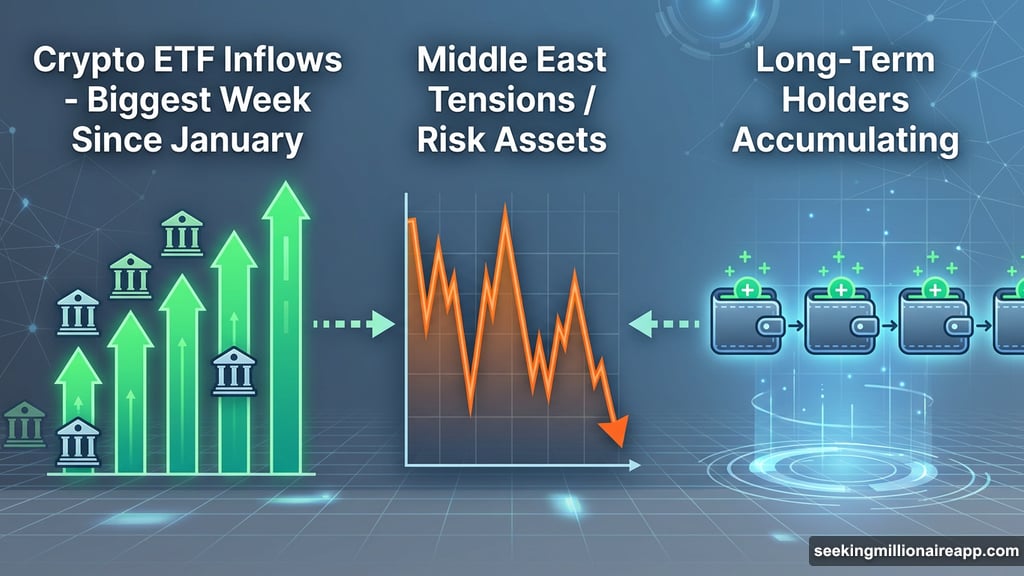
Markets don’t move in a vacuum. Ongoing Middle East tensions have been weighing on risk assets globally, and crypto hasn’t been immune to that pressure. When broader sentiment turns nervous, leveraged positions in volatile assets become especially dangerous.
Still, not everything points negative. Institutional flows have remained supportive throughout the turbulence. Crypto ETFs just recorded their biggest inflow week since January, according to the data. That kind of institutional backing suggests confidence hasn’t evaporated at the larger scale.
On-chain data adds another layer to that picture. Long-term holders continue accumulating through the chaos, which historically signals that bigger investors see current prices as an opportunity rather than a warning sign.
Why Short Squeezes Matter for What Comes Next
A short squeeze isn’t just painful for the traders who get caught. It can also act as a signal about market direction.
When short sellers get forced to buy back their positions to cover their losses, that buying pressure adds fuel to the rally. It can trigger further upside as more shorts rush to exit, which creates a feedback loop. That’s partly why recoveries following a squeeze can move faster than people expect.
However, $422 million in 24-hour liquidations is still a very elevated number. It points to a market where rapid swings in both directions remain very much alive. No single squeeze guarantees a sustained recovery.
The real takeaway here isn’t about bulls or bears winning. It’s about what happens when too much leverage meets fast-moving markets. Positions that look safe one hour can be underwater the next. The traders who survived this stretch intact were almost certainly the ones using less leverage to begin with.
For anyone watching crypto right now, the pattern is worth keeping in mind. Long-term holders accumulating quietly while leveraged traders get liquidated in both directions is a setup that tends to resolve upward eventually. But the road there can stay bumpy for a while.