
Bitcoin is sitting at a tricky crossroads right now. The price looks fine on the surface — trading around $74,815 inside a steady ascending channel. But underneath that calm exterior, three separate warning signals have fired off in just three days. And the biggest holders in the market? They’re quietly heading for the exit.
Let’s walk through exactly what’s happening and why it matters for where Bitcoin heads next.
The Ascending Channel Hides Some Serious Cracks
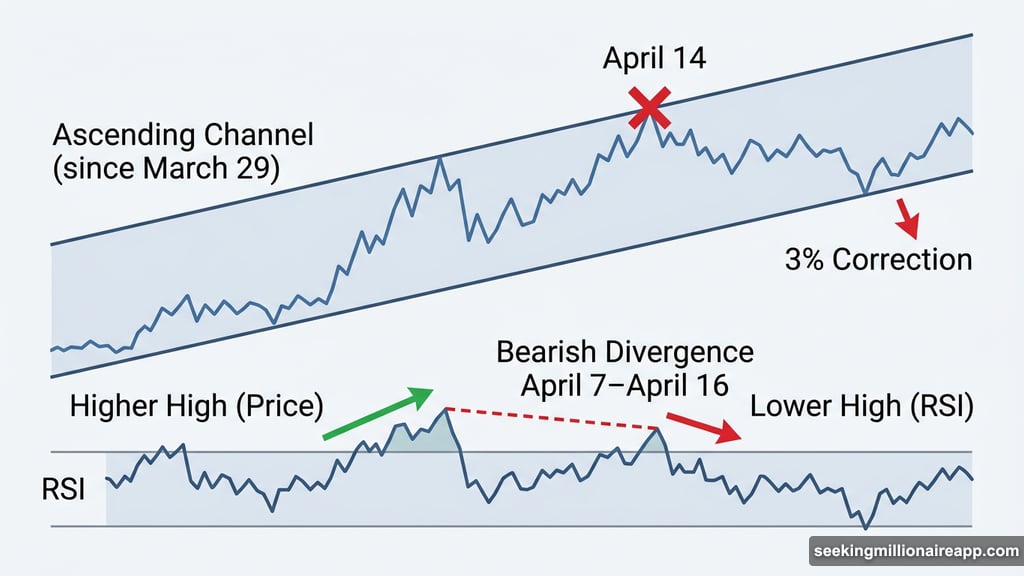
Bitcoin has been climbing inside an ascending channel since March 29. That means every price low has been higher than the last, and every peak has pushed a little further up. Sounds bullish, right?
Here’s the problem. Price is now bumping against the top of that channel, and three separate warning signs appeared between April 14 and April 16 — almost back to back.
The first warning hit on April 14. Bitcoin approached the upper channel boundary and simply couldn’t break through it. That rejection was the first hint that buying pressure was running thin.
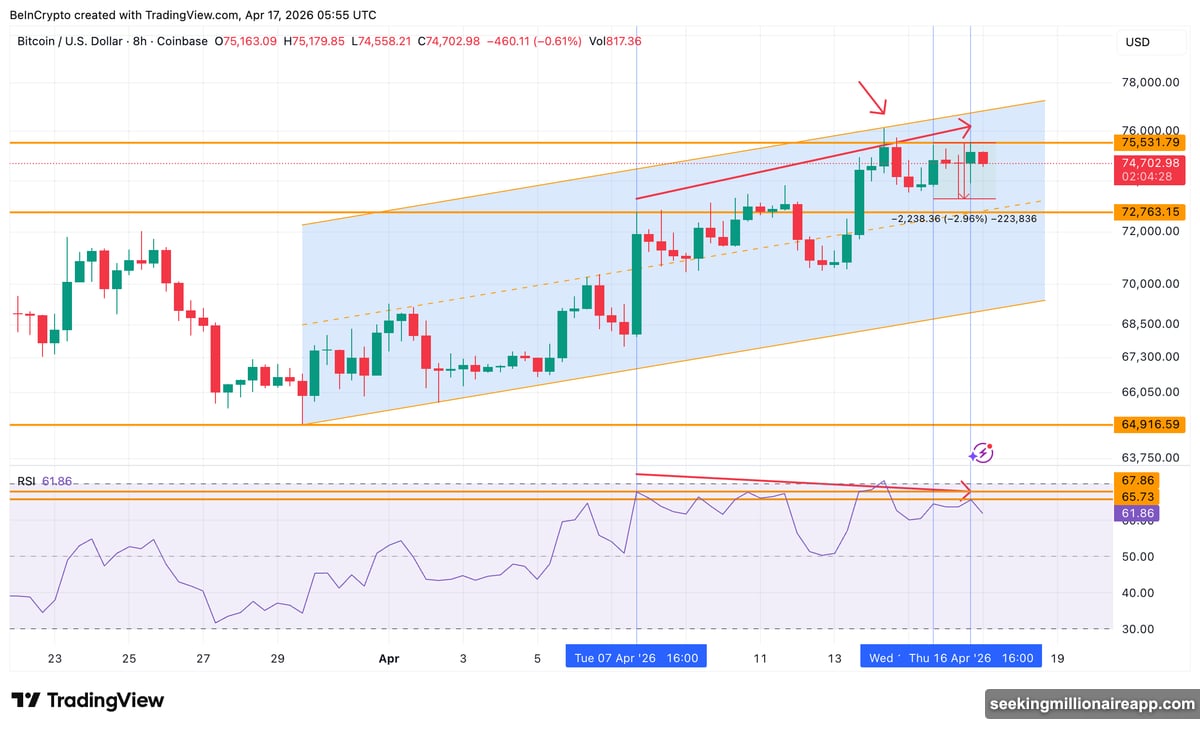
Then came the second warning, building between April 7 and April 15. This one involves the Relative Strength Index (RSI) — basically a momentum gauge that tells you how much force is behind a price move. Bitcoin’s price made a higher high, but the RSI made a lower high. That mismatch is called a bearish divergence, and it led to about a 3% correction shortly after.
But here’s where it gets interesting. A third warning appeared between April 7 and April 16. Again, price pushed to a higher high. Again, the RSI printed a lower high compared to April 7. That creates back-to-back bearish divergences — a rare pattern that analysts take seriously, because momentum is fading even as price climbs.
One failed breakout plus two divergences in the same week is a combination that rarely resolves in the bulls’ favor.
Bitcoin Whale Holdings Are Dropping Fast
While the charts flashed warnings, the biggest Bitcoin holders started quietly unloading. On-chain data from Santiment reveals that the two largest whale cohorts have been reducing their positions at the same time the technical signals appeared.
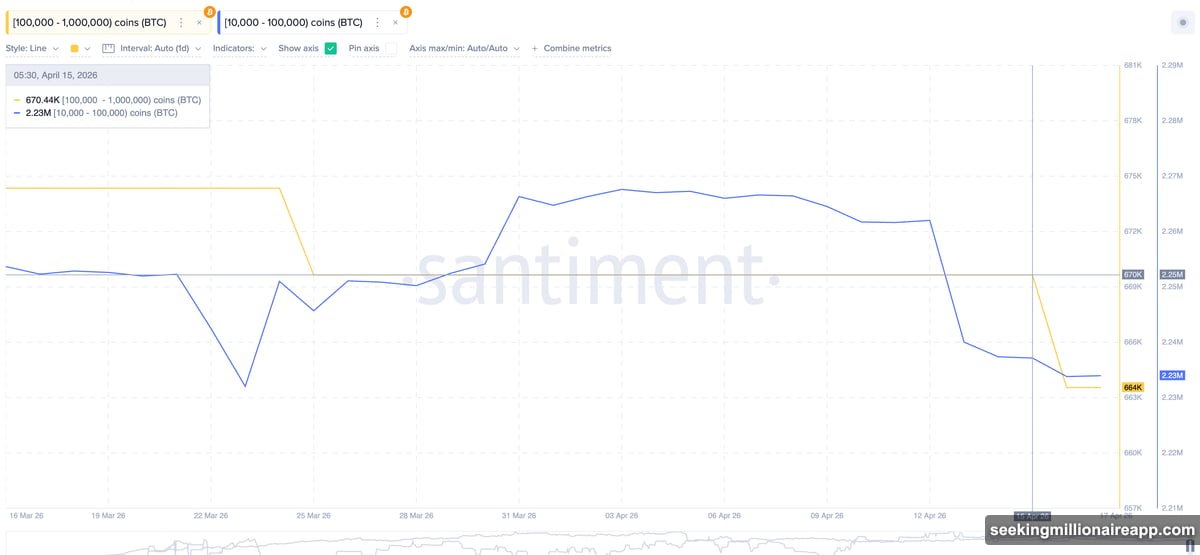
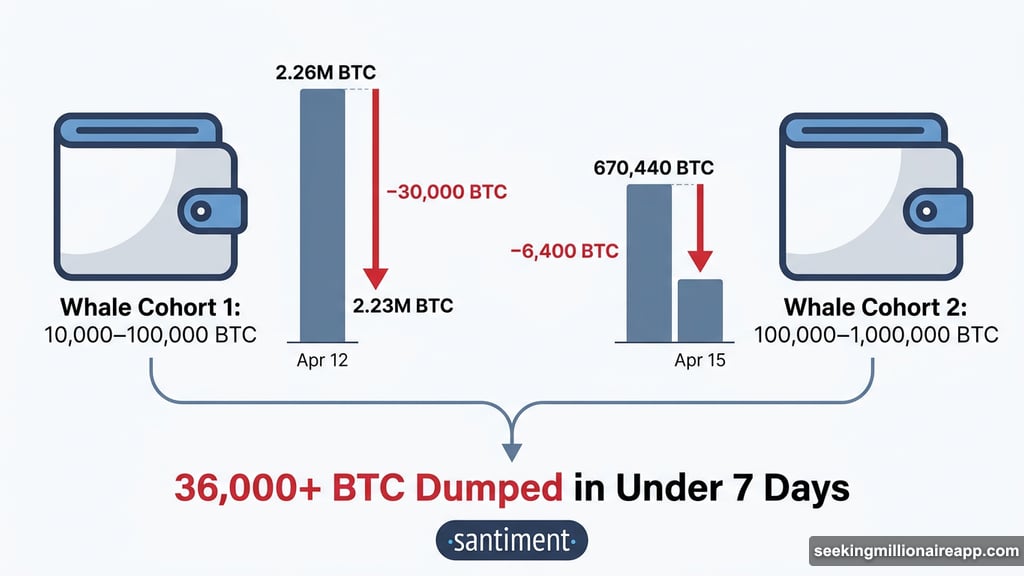
The first group — wallets holding between 10,000 and 100,000 BTC — actually started selling before the chart warnings even formed. Their collective holdings dropped from 2.26 million BTC on April 12 to 2.23 million BTC shortly after. That’s roughly 30,000 BTC offloaded in under a week.
The second group — wallets holding between 100,000 and 1 million BTC — began selling on April 15. That’s almost exactly when the first full bearish divergence confirmed on the chart. Their holdings fell from 670,440 BTC down to about 664,000 BTC, a drop of around 6,400 BTC.
Add those two cohorts together and you get over 36,000 BTC dumped in less than seven days. That’s not noise. Whales tend to move early when they sense structural weakness forming, and the timing here lines up almost perfectly with the technical warnings.
Long Liquidation Risk Adds More Pressure
The derivatives market paints an equally cautious picture. According to Coinglass data from Bybit’s 7-day liquidation map, cumulative long liquidation leverage sits at $2.37 billion. Short liquidation leverage stands at just $1.31 billion.
That’s roughly a 2-to-1 tilt in favor of longs. In plain terms, a lot more money is betting on Bitcoin going up than going down. So if prices dip, longs get squeezed out — and those forced liquidations can push prices down further, fast.
Heavy long positioning on top of whale distribution on top of two bearish divergences creates what traders call long squeeze conditions. It’s not inevitable, but the setup has all the right ingredients.
The Key Price Levels to Watch
Bitcoin at $74,815 sits right between two critical decisions.
On the upside, $76,130 is the line to watch. A clean close above that level on the 8-hour chart would start forcing out the stacked short positions and could open a path considerably higher.
On the downside, the first real test comes at $73,484 — the 0.236 Fibonacci retracement level. Losing that support would likely mirror the previous divergence’s 3% drop, which would put $71,846 (the 0.382 Fibonacci) in play. Below that sits $70,523 (the 0.5 Fibonacci level).
The more serious level is $69,199 — the 0.618 Fibonacci. A close below that would align with the lower trendline of the entire ascending channel. Breaking that trendline would invalidate the bullish structure that’s been holding since March 29. If that happens, the targets below open at $67,315 and then $64,915.
In short, $73,484 is the pivot. Hold above it and Bitcoin can stay in recovery mode. Lose it and things could move down quickly.
What This Setup Actually Means
Three bearish divergences in three days is already unusual. Layer in whale selling that started before most traders noticed the warnings, and you start to understand why the risk here feels asymmetric.
That said, Bitcoin has defied bearish setups before. A clean breakout above $76,130 would change the picture fast. But until that happens, the evidence tilts toward caution. The biggest holders in the market seem to agree — they’re not waiting around to find out.
Watch those key Fibonacci levels closely over the next few sessions. They’ll tell you which story wins.