Bangkok is about to become the center of global finance. And not just for a few days.
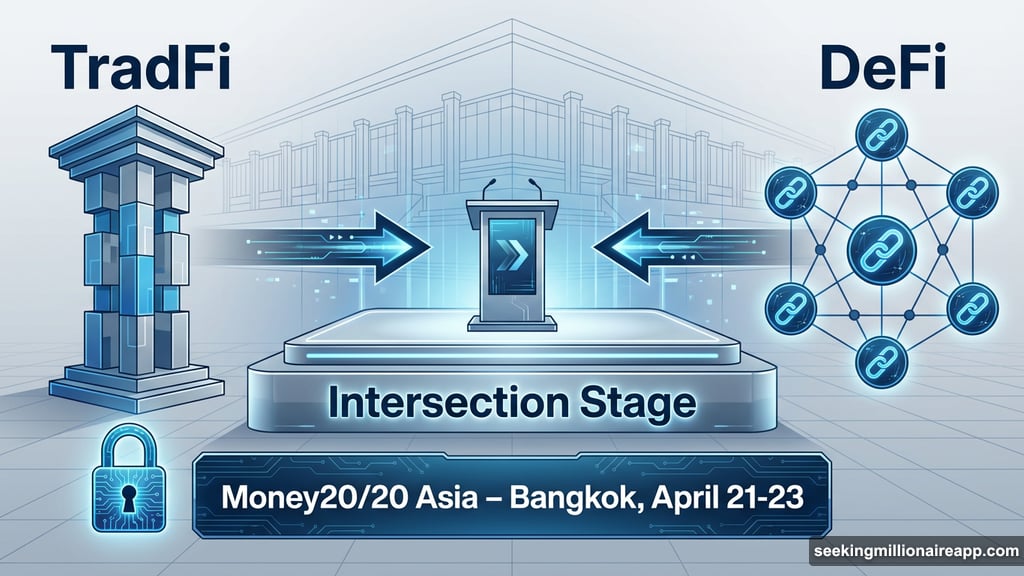
Money20/20 Asia is launching something genuinely exciting for its April 21-23 event at the Queen Sirikit National Convention Center. The Intersection Stage brings together traditional banks, digital asset players, regulators, and Web3 builders under one roof. Plus, this isn’t a one-off experiment. It marks the start of a unified global program rolling out across Money20/20 events in Asia, Europe, and the United States.
So if you’ve been watching the slow dance between Traditional Finance (TradFi) and Decentralized Finance (DeFi), Bangkok is where that dance finally becomes a duet.
TradFi and DeFi Stop Fighting, Start Merging
For decades, these two worlds couldn’t agree on much. Traditional finance wanted to protect existing systems. DeFi wanted to burn them down and start fresh. Neither approach worked perfectly on its own.
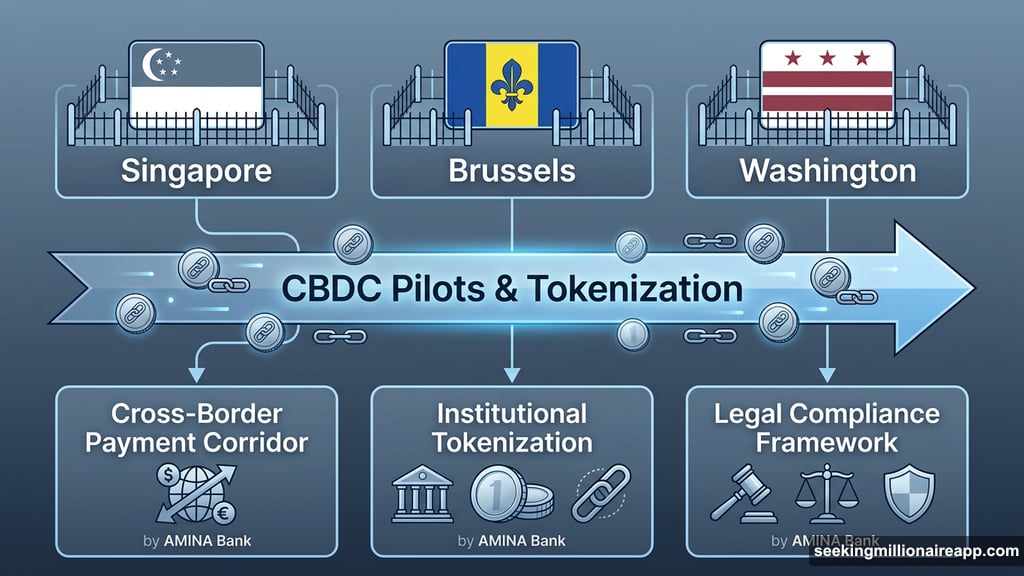
But something shifted. Digital money now crosses borders faster than any legacy system can track. Regulators from Washington to Brussels to Singapore are building frameworks that actually make room for both worlds. And the companies caught in the middle are tired of waiting.
Danny Levy, EVP and Managing Director for APAC and the Middle East at Money20/20, put it plainly. “For decades, Traditional Finance aimed to protect the system while Decentralized Finance wanted to reinvent it. Now these two worlds are converging at a pivotal moment where digital money crosses borders faster than ever and decision-makers are setting frameworks that will guide the next decade.”
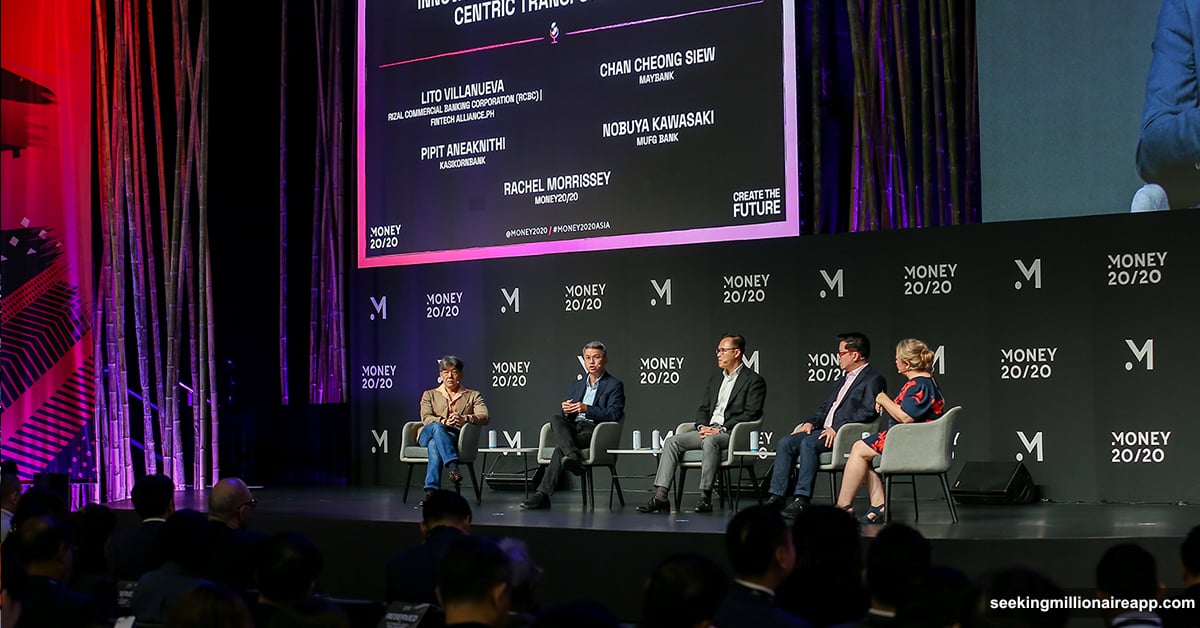
Asia, he says, is leading this transformation. And the Intersection Stage exists specifically to host those conversations.
Why Asia Leads This Shift
This isn’t just conference hype. Asia genuinely sits at the frontier of financial infrastructure right now.
Several countries across the region are running advanced central bank digital currency (CBDC) pilots. Real-time cross-border payment corridors already operate at scale. Institutional tokenization projects that most Western markets are still theorizing about are actively being tested in Asia.
What makes Asia’s approach notable is the balance between speed and caution. Regulatory sandboxes give innovators room to experiment without putting consumers at risk. That balance is exactly what the global fintech industry needs to study.
Cora Ang, Head of Legal and Compliance APAC at AMINA Bank, sees this clearly. “Asia is demonstrating what responsible innovation truly looks like. As digital assets, tokenization, and new payment rails gain momentum, strong legal and compliance frameworks are essential to scaling them safely. The Intersection Stage at Money20/20 Asia is the perfect forum to advance these conversations.”
Digital Identity and Trust Power the Whole System
Here’s the part that often gets overlooked in TradFi-DeFi conversations. None of this convergence works without proper identity verification and fraud prevention.
Banks and crypto exchanges are both grappling with the same underlying problem. How do you verify who someone is, comply with regulations, and still deliver a smooth customer experience? That challenge doesn’t get easier when you’re operating across multiple jurisdictions with different rules.
Siva Kumar, APAC Legal Director at Sumsub, described what he’s seeing on the ground. “The convergence of TradFi and DeFi will only scale if trust is underpinned by robust digital identity verification, effective fraud prevention, and compliance that can keep pace with innovation. We’re seeing banks, digital asset service providers, exchanges, and fintechs embrace full-cycle verification and reusable digital identities to secure every step of the customer journey.”
Reusable digital identities are particularly interesting here. Instead of completing fresh verification checks every time a user opens a new account or uses a new service, a verified identity can travel with them. That’s a meaningful improvement for users and a cost saver for institutions.
The Regulatory Landscape Getting Clearer
One of the biggest themes at the Intersection Stage will be regulation. And for once, the conversation sounds optimistic.
The US Genius Act, Europe’s MiCA framework, and Asia’s various sandbox programs represent real progress. They’re not perfect. But they signal that governments are trying to create workable rules rather than simply banning things they don’t understand.
For institutions like AMINA Bank, navigating this patchwork of regulations is a daily challenge. For companies like Sumsub, it’s about building compliance tools that work across all of those different environments simultaneously.
The Intersection Stage tackles this directly with a session on Day 1 called “Cross-Border by Design: Regulation as the Great Connector.” That panel includes voices from Bank of America, Sumsub, Herbert Smith Freehills Kramer, and AMINA Bank. The title says everything. Regulation isn’t just a barrier. Done right, it’s actually the infrastructure that connects different financial systems.
What’s on the Schedule
The session lineup covers a lot of ground across two days.
Day 1 on Tuesday, April 21 opens with a session by Ernst and Young’s Chee Keong Teo on integrating blockchain into traditional finance systems. That’s followed by a panel on building what speakers are calling the “golden record” for tokenized asset markets, featuring voices from Reed Smith Singapore, Northern Trust, and Libeara.
Day 2 on Wednesday, April 22 goes deep on stablecoin payment rails with executives from VelaFi, Trace Finance, Uquid, and Pantera Capital. Another session runs simultaneously on institutional digital asset payments moving “from concept to capability,” with speakers from Zodia Custody, Reap, WalletConnect, Kraken, and Nethermind.
That’s a serious list of names. These aren’t theoretical discussions. These are people actively building and running systems that process real money at scale.
What Money20/20 Asia Means for the Broader Industry
Money20/20 has been around since 2012 and has grown into one of the most credible stages in global fintech. Mastercard, Stripe, Visa, J.P. Morgan, Google, and Airwallex have all used it to announce partnerships, close deals, and signal strategic direction.
The Intersection Stage adds a new dimension to that legacy. By specifically dedicating programming to the TradFi-DeFi convergence, Money20/20 is acknowledging what the market already knows. These two worlds aren’t separate anymore. The question isn’t whether they merge. It’s how fast, and on whose terms.
Bangkok in April is where some of those terms get set. Whether you’re a banker exploring tokenization, a crypto company chasing institutional clients, or a regulator trying to build frameworks that don’t stifle innovation, the Intersection Stage is designed for exactly that conversation.
The fintech industry has spent years talking about convergence. It’s finally showing up in person.