A new survey just painted a fascinating picture of where Europe stands on cryptocurrency. Spoiler: it’s a lot further along than most people expected.
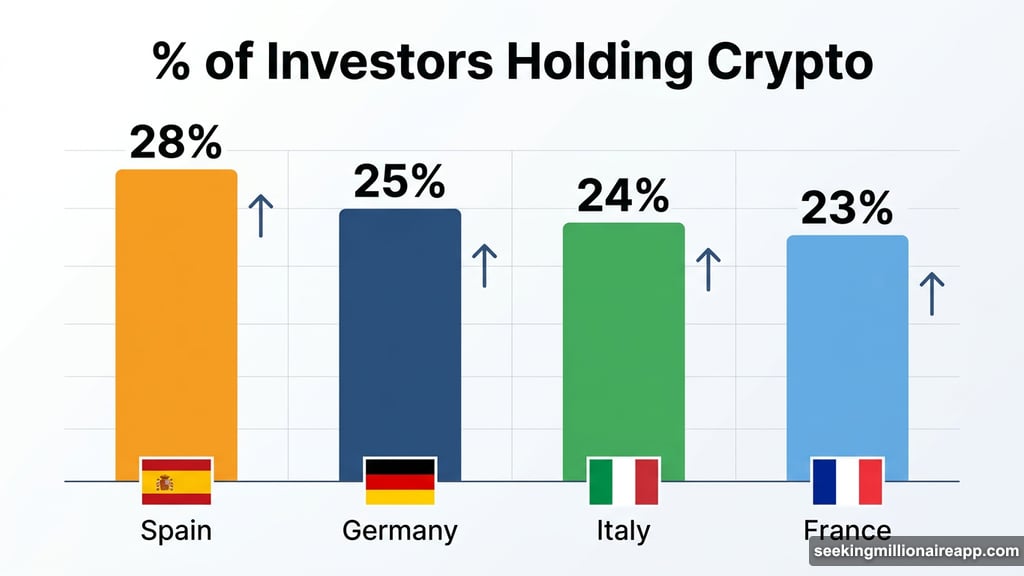
Marketagent, a market research firm, polled 6,000 investors aged 18 to 70 across Germany, Italy, Spain, and France between August 2025 and January 2026. The results, highlighted by Boerse Stuttgart Digital, show that 25% of European investors now hold crypto. That’s one in four people. And the number keeps climbing.
So what does this actually mean for everyday investors, banks, and the financial industry? Quite a lot, it turns out.
Spain Leads European Crypto Adoption Rates
Spain sits at the top of the adoption rankings, with nearly 28% of investors holding cryptocurrency. Germany comes in second at 25%, followed closely by Italy at 24% and France at 23%.
But raw adoption numbers only tell part of the story. The really interesting data is what investors plan to do next.
Thirty-six percent of current crypto holders say they plan to reinvest within five years. And again, Spain leads the pack. Over 40% of Spanish investors express strong ongoing interest. France follows at 36%, Germany at 35%, and Italy at 34%.
Dr. Matthias Voelkel, CEO of Boerse Stuttgart Group, noted that the sustained intention to invest further, even amid market volatility, is just as significant as the initial adoption numbers. That’s not a flash-in-the-pan trend. That’s a structural shift in how Europeans think about investing.
Complexity Still Blocks Many Potential Investors
Here’s the catch. Despite growing enthusiasm, most European investors still find crypto confusing.
In Spain and France, 73% of investors say crypto feels too complex. Italy sits at 70%, while Germany fares slightly better at 65%. Still, even Germany’s “better” number means nearly two-thirds of investors feel overwhelmed.
The good news? Education could unlock significant new investment. Fifty-four percent of Spanish investors say they would put more money into crypto if they understood it better. France follows at 49%, with Italy and Germany both at 44%.
That’s a massive untapped audience waiting for clearer information and simpler tools. Better financial education isn’t just a nice idea here. It’s a direct path to broader participation.
Banks Face a Crypto Wake-Up Call
Perhaps the most striking finding from the survey isn’t about crypto itself. It’s about what investors expect from their banks.
Nearly one in five European investors expect their bank to offer crypto access within three years. Germany leads that expectation at 22%, followed by Spain at 19%, Italy at 18%, and France at 16%.
And banks that ignore this signal could literally lose customers over it. Thirty-five percent of European investors say they would consider switching banks for better crypto services. Spain shows the strongest inclination at 40%, ahead of Italy at 35%, France at 33%, and Germany at 29%.
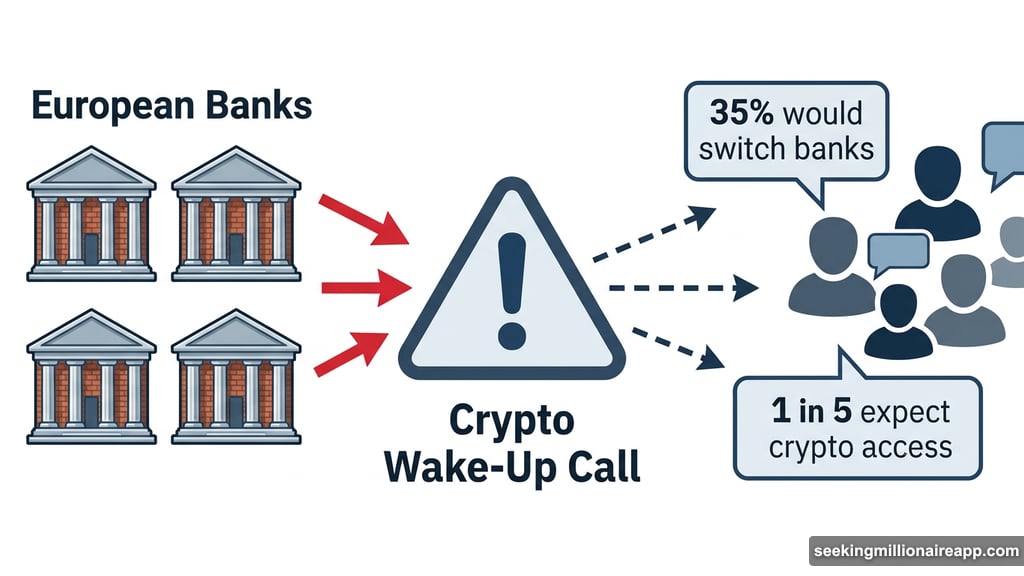
Think about that for a moment. More than a third of investors are willing to move their banking relationship for better access to digital assets. That’s not a niche demand anymore. That’s a competitive battleground.
Boerse Stuttgart Digital explicitly flagged this as a strategic opportunity for banks, brokers, and asset managers. The institutions that build solid crypto infrastructure now will likely capture significant market share from slower-moving competitors.
Crypto Moves Into the Political Mainstream
The European findings also connect to a broader shift happening across the Atlantic. In the United Kingdom, cryptocurrency is becoming a genuine political issue.
Adriana Ennab, UK Director at Stand With Crypto, told BeInCrypto that the organization is already tracking what it calls the “crypto voter.” Her view is that this group will only grow in political importance over time.
Dion Seymour, Crypto Tax Technical Director at Andersen and a former HMRC policy lead, reinforced this point. The growing number of UK crypto holders means the issue is no longer a niche concern for tech enthusiasts. It now demands real political attention from lawmakers and regulators.
Together, these developments point in one direction. Crypto is no longer a fringe investment class discussed in online forums. It’s a mainstream financial product that voters hold, that banks need to offer, and that governments can’t afford to ignore.
The survey data from Boerse Stuttgart Digital makes one thing clear. European investors have already made their move. Now it’s time for the institutions around them to catch up.