Tether just made its biggest enforcement move ever. And the numbers are genuinely staggering.
On April 23, 2026, Tether froze $344 million in USDT across two Tron wallets. The action happened in direct coordination with the Office of Foreign Assets Control (OFAC) and U.S. law enforcement agencies. Both wallets were flagged for sanctions evasion and connections to criminal networks.
This wasn’t a routine compliance check. It was a targeted, intelligence-driven strike.
Two Tron Wallets, Two Very Large Numbers
The frozen wallets held $212.9 million and $131.3 million respectively. Together, they add up to Tether’s largest single enforcement action on record.
U.S. authorities shared intelligence about both addresses before Tether acted. That coordination matters. It means the freeze happened fast enough to stop funds from moving elsewhere.
Tether CEO Paolo Ardoino put it plainly in the company’s announcement: “USD₮ is not a safe haven for illicit activity. When credible links to sanctioned entities or criminal networks are identified, we act immediately and decisively.”
That’s a strong statement. But the track record backs it up.
This Doubles the Previous Record
For context, Tether’s previous largest single enforcement action froze $182 million across five Tron wallets back in January 2026. The new action nearly doubles that figure in just two wallets.
And that’s just the latest chapter in a much longer story. Tether has now frozen more than $4.4 billion in total assets linked to illicit activity. Over $2.1 billion of that connects directly to U.S. law enforcement cases.
Those aren’t small numbers. That’s a serious enforcement infrastructure operating at real scale.
Tether Works With 340+ Law Enforcement Agencies Worldwide
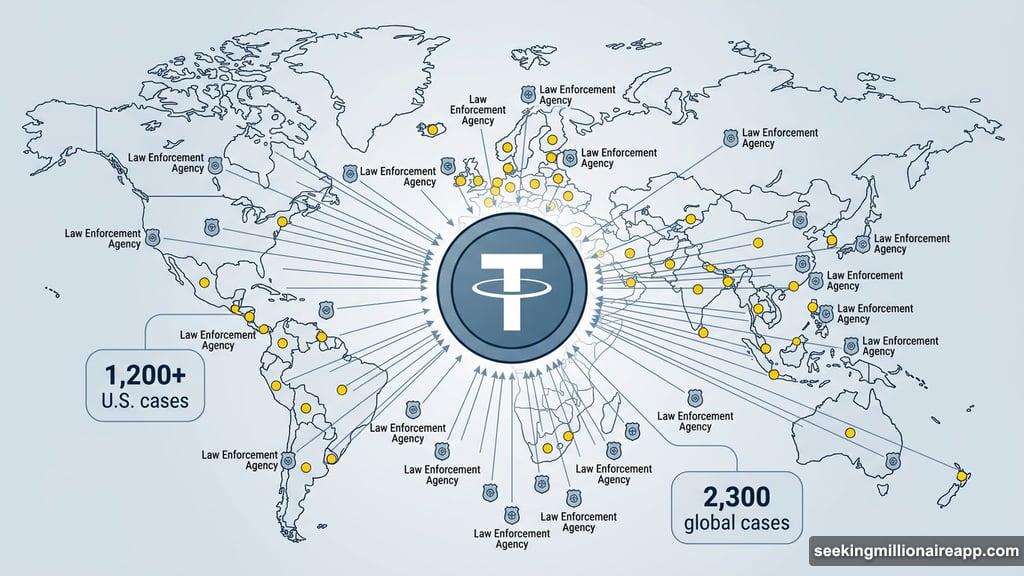
Here’s something that surprises a lot of people. Tether currently partners with more than 340 law enforcement agencies across 65 countries. That cooperation has supported over 2,300 cases globally, with more than 1,200 tied specifically to U.S. authorities.
So when a freeze like this happens, it’s rarely spontaneous. It’s the result of ongoing intelligence sharing between Tether and federal agencies working active investigations.
The U.S. Department of Justice has previously acknowledged Tether’s role in enforcement actions that led to seizures of nearly $61 million and about $225 million tied to pig butchering fraud schemes. Those are real criminal networks that lost real money because of blockchain traceability.
Why Blockchain Makes This Possible
This is where things get genuinely interesting. Critics often argue that crypto enables crime by letting bad actors move money outside the traditional banking system. But this freeze tells a different story.
Public blockchains leave a traceable record of every transaction. Unlike cash, which disappears once it changes hands, on-chain activity stays visible forever. Investigators can follow funds across wallets, across time, and across jurisdictions.
Traditional cash transfers simply can’t offer that kind of audit trail. A suitcase of money moves once and leaves no digital footprint. A Tron wallet that receives $212 million in USDT? That transaction lives on-chain permanently.
That’s exactly what OFAC and U.S. law enforcement used here. Intelligence plus traceability equals a targeted freeze before the funds could scatter.
What This Means for Stablecoin Compliance
Stablecoins like USDT occupy a unique position in the crypto ecosystem. They’re designed to stay stable in value, which makes them useful for everyday transactions. But that same stability makes them attractive to bad actors trying to preserve value while moving money.
Tether’s response has been to build compliance infrastructure that rivals traditional financial institutions. Working with 340+ agencies, supporting thousands of cases, and maintaining the technical ability to freeze wallets on short notice requires serious operational commitment.
The $344 million freeze shows that stablecoin issuers can serve as genuine enforcement partners. That’s a meaningful shift from just a few years ago, when regulators viewed crypto largely as a compliance blind spot.
Whether you’re a casual crypto user or a professional keeping tabs on stablecoin regulation, this action signals something important. The “crypto is untraceable” narrative is fading fast. And the largest stablecoin in the world is actively helping federal agencies prove it.