
The crypto market just hit a wall. After weeks of slow recovery, the total market cap slipped 0.77% to $2.57 trillion on April 23, erasing $19.45 billion in a single session.
Three forces collided at once. Bitcoin got rejected at a critical resistance level. DeFi took a brutal hit from a major hack. And capital appears to be flowing back into traditional equities. None of that is great news for bulls hoping the worst is behind them.
S&P 500 Rally Pulled Liquidity Away From Crypto
The S&P 500 closed higher on April 22 at 7,114.58. And right on cue, crypto slipped.
This isn’t a coincidence. The same pattern has repeated throughout April. Green days on the S&P 500 line up with flat or red sessions in crypto. That points strongly to a fund rotation thesis, where institutional money moves toward equities when stocks look attractive and away from digital assets.
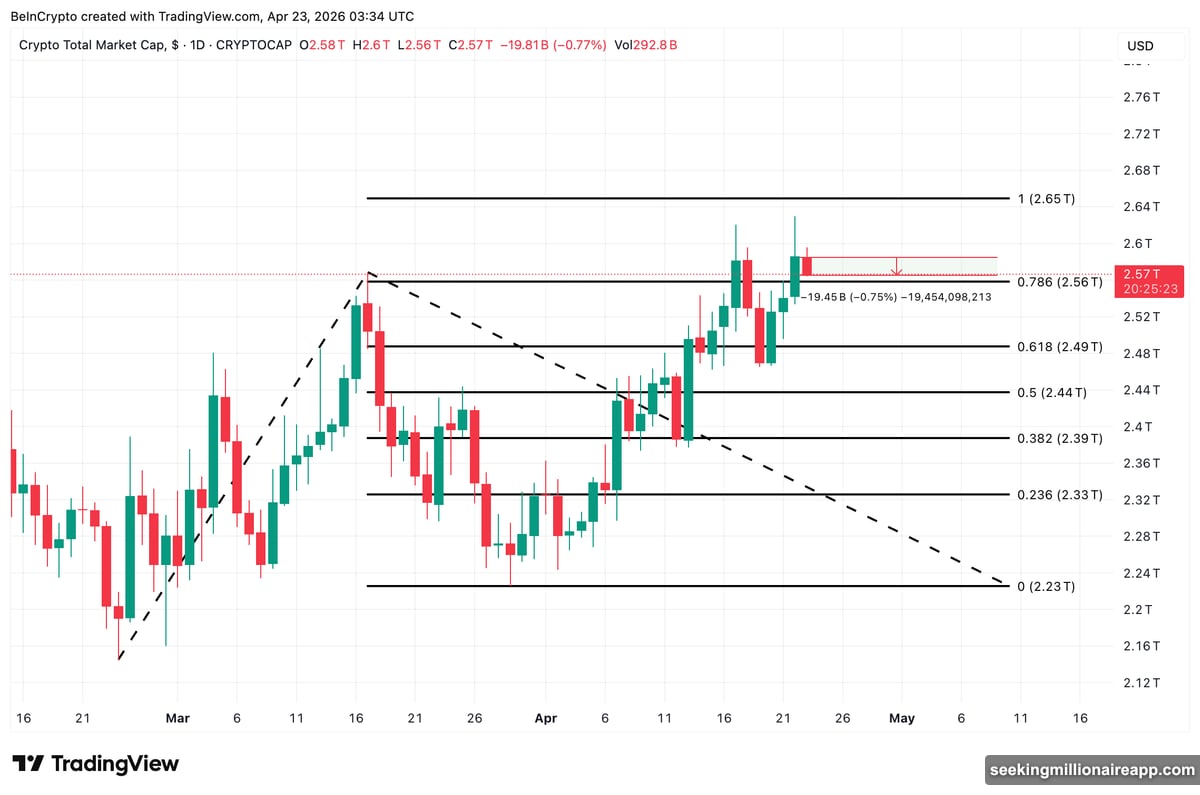
The crypto market also ran into a technical brick wall this week. Price pushed into the 0.786 Fibonacci retracement zone near $2.56 trillion before rolling over. The next major hurdle sits at $2.65 trillion. Getting there requires a lot more conviction than the market has shown lately.
Bitcoin’s Rally Looks Structurally Weak
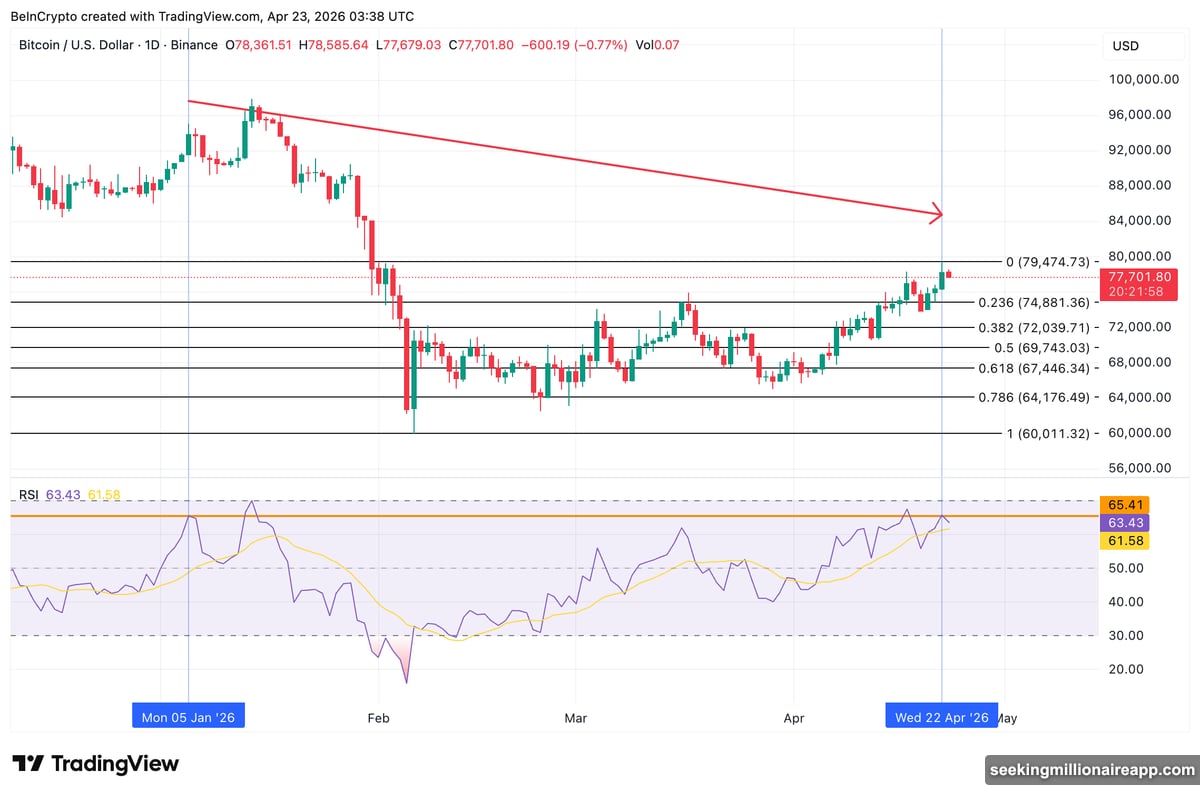
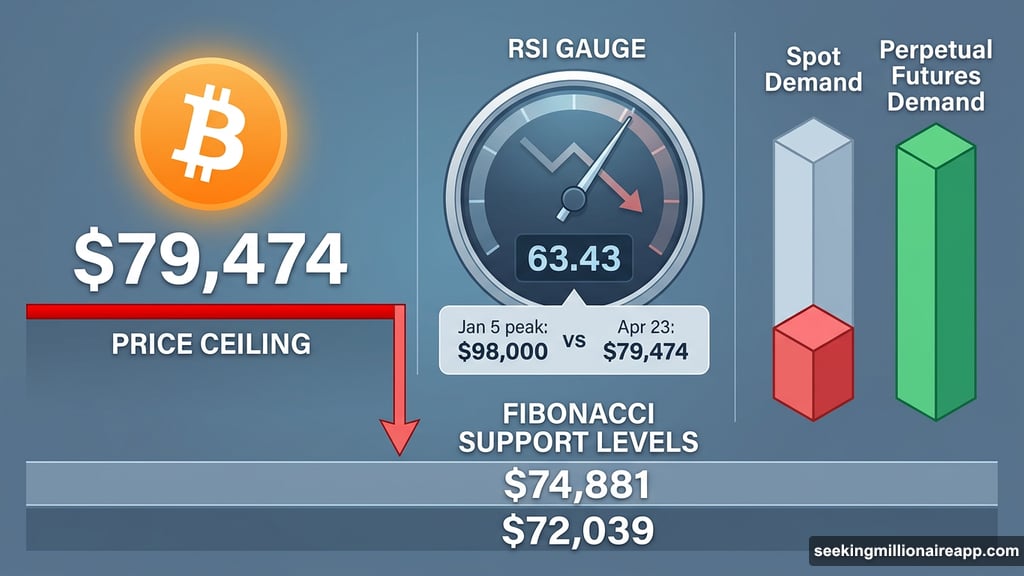
Bitcoin fell to $77,701 on April 23 after stalling near the $79,474 recovery peak hit just one day earlier. That level marks the top of the bounce from the February low, and the market treated it as a hard ceiling on the first test.
What makes this rejection more concerning is the momentum data underneath it. Bitcoin’s Relative Strength Index (RSI) printed 63.43 on April 22. That’s nearly identical to the RSI reading during the January 5 swing peak. But here’s the problem: back in January, that RSI reading matched a price near $98,000. This time, the same momentum reading only pushed price to $79,474.
Same fuel, much weaker result. That’s a classic hidden bearish divergence.
The flow data backs this up. According to CryptoQuant, the recent bounce has been driven almost entirely by perpetual futures demand. Spot demand, the kind that signals real organic buying, keeps contracting. That’s the same setup that preceded Bitcoin’s fall from $98,000 earlier this year.
A daily close above $79,474 would change the picture and open the door higher. But a close below the 0.236 Fibonacci level at $74,881 exposes $72,039, with $69,743 as the next major support below that.
KelpDAO Hack Crushed DeFi Sentiment
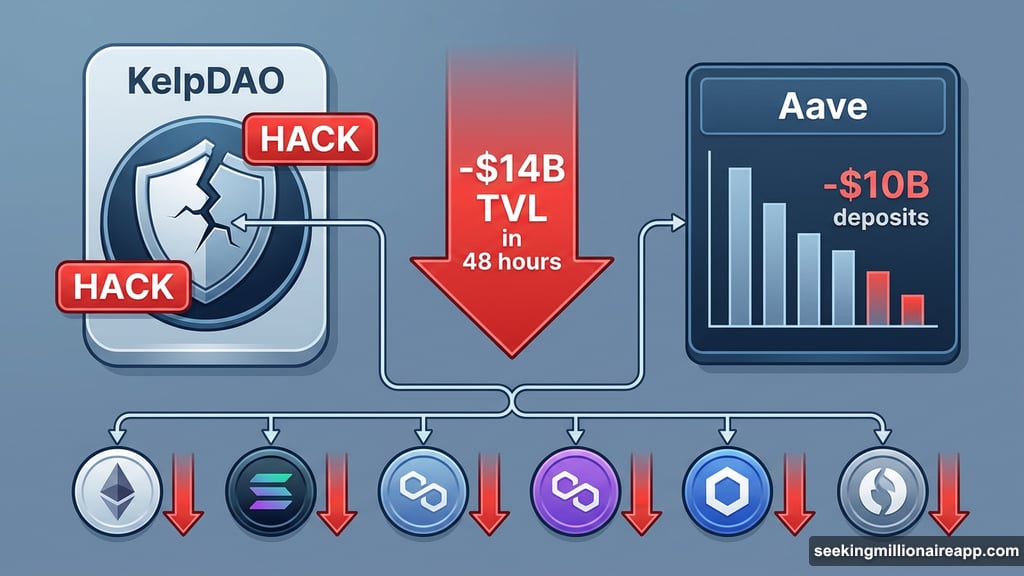
While Bitcoin wrestled with its own technical problems, the broader DeFi sector took a separate hit. Total value locked (TVL) across DeFi dropped $14 billion in just 48 hours following the KelpDAO hack.
Aave alone lost $10 billion in deposits during that stretch. That’s a staggering single-protocol outflow. And it dragged down altcoins across the board as confidence in DeFi protocols took a sharp knock.
Ethena (ENA) felt that pain directly. The token dropped over 6% to $0.104, sliding below the 0.5 Fibonacci support level. A bullish cup and handle pattern has been forming on ENA’s chart, but the handle pullback has stretched further than typical. There’s a small silver lining: sell-side volume appears to be declining, which could signal the end of the pullback rather than the beginning of a deeper breakdown.
For ENA to recover, it needs to reclaim $0.106, then push toward $0.122. A move above $0.144 would confirm a full pattern breakout and potentially activate a 70% upside projection. On the downside, a drop below $0.099 shifts the outlook negative, with $0.076 as the next key base.
One Bright Spot Worth Watching
Not everything moved down today. BlackRock’s iShares Bitcoin Trust (IBIT) hit a record 806,700 BTC in holdings, worth roughly $63.7 billion, after nine straight days of net inflows. That’s institutional conviction holding firm even as price weakens.
And Binance captured 54% of oil perpetual futures volume in a single day, pointing to growing appetite for traditional asset exposure through crypto-native instruments. That’s an interesting trend to watch as the lines between TradFi and DeFi keep blurring.
What Needs to Happen Next
The recovery from March’s lows was always going to face a test. That test is happening right now.
The market’s dependence on leveraged futures rather than spot buying is the core vulnerability. Leverage-driven rallies are fragile. When they hit resistance, the pullbacks come fast and sharp, exactly what played out today.
Bulls need $2.56 trillion to hold as support on the total market cap. If that level gives way, the 0.618 Fibonacci at $2.49 trillion comes into play, followed by $2.44 trillion. Neither of those outcomes would feel great after weeks of slow recovery progress.
The cleaner the spot demand picture gets, the more sustainable any future rally becomes. Until that changes, price action will likely stay choppy and reactive to whatever equities do next.